

What is SAP ECC?
For many years, thousands of businesses all over the world have relied on SAP ECC (ERP Central Component) as their operational foundation. It transformed how businesses handle their data as the main component of the SAP Business Suite, enabling smooth communication between sales, finance, logistics, and human resources.
But the ERP environment is changing. SAP is directing its user base toward its next-generation platform, S/4HANA, in response to the growth of cloud computing and artificial intelligence. Understanding SAP ECC's capabilities, its impending sunset, and how to close the gap with partners like SEPFUST is essential for your company's survival and expansion if it is still using it.
How Useful is SAP ECC?
Beyond software, SAP ECC is a "System of Record." Integration is where it is most useful. Prior to ECC, companies frequently operated in silos: Finance had to wait weeks for month-end reports, and Sales was unaware of what Inventory held.
This was resolved by SAP ECC by:
- Centralizing Data: Providing all business departments with a single source of truth.
- Standardizing Processes: forcing organizations to adopt best-practice workflows for procurement, sales, and production.
- Scalability: Able to manage millions of transactions for global firms.
What are the capabilities of SAP ECC?
SAP ECC is famous for its modular structure. Companies can implement the specific capabilities they need. The most critical modules include:
- FICO (Finance & Controlling): The heart of ECC, managing financial accounting, reporting, and internal cost controls.
- MM (Materials Management): Handles procurement, inventory management, and vendor valuation.
- SD (Sales & Distribution): Manages the entire sales lifecycle from order to delivery and billing.
- PP (Production Planning): Aligns manufacturing capacity with material availability.
- Human capital management, or HCM, is in charge of hiring, timekeeping, and Beyond modules, ECC is very adaptable thanks to the ABAP programming language, which enables companies to customize the system to their particular requirements.P programming language, allowing businesses to tailor the system to their exact unique needs.
SAP ECC vs SAP S/4HANA Differences
The biggest question for IT leaders is: What is the difference between what I have (ECC) and where I need to go (S/4HANA)?
| Feature | SAP ECC | SAP S/4HANA |
| Database | Runs on AnyDB (Oracle, SQL, IBM, etc.) | Runs only on HANA (In-Memory Database) |
| Speed | Transactional processing (can be slower for massive reports) | Real-time processing and analytics |
| User Interface | Traditional SAP GUI (Complex, gray screens) | SAP Fiori (Modern, app-like experience) |
| Architecture | Complex tables with aggregate data | Simplified "Universal Journal" (ACDOCA) |
| Flexibility | Rigid, on-premise focus | Cloud-first, flexible, and AI-ready |
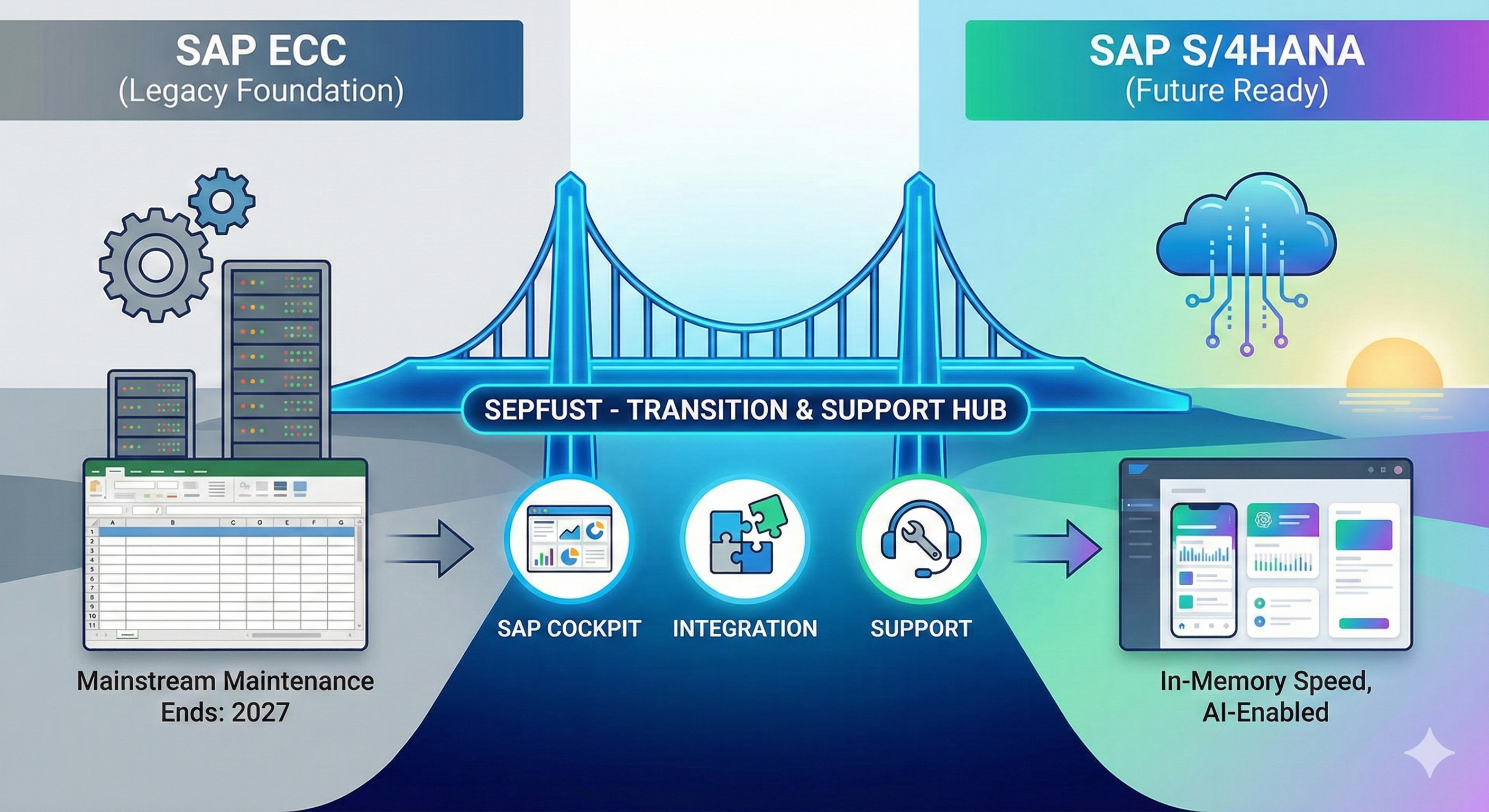
For Understanding the comparison you can read the blog - SAP ECC vs SAP S/4 HANA
Why is SAP Discontinuing ECC?
SAP is not just retiring a product; they are retiring an old way of thinking. ECC is being discontinued because:
- Legacy Architecture: ECC was built for the disk-based database era. It cannot leverage modern speed (In-Memory computing) or AI capabilities.
- The Cloud Shift: Software as a Service, or SaaS, is taking over the world. SAP wants cloud users to secure revenue and push updates more quickly.
- Innovation Stagnation: Innovation is slowed down by maintaining outdated codebases. SAP is able to incorporate IoT and machine learning right into the core thanks to S/4HANA.
Dates for Discontinuation (The Deadline)
Now is the time to plan your migration. The time is running out:
- Mainstream Maintenance Will End on December 31, 2027
- Standard support ends on this date.
- December 31, 2030 is the end date of optional or additional maintenance.
- requires a premium payment (typically +2%) in order to maintain support.
Your system is at risk of security flaws and noncompliance if you do not migrate or obtain support by these deadlines.
How SEPFUST Powers Your SAP Journey
SEPFUST bridges the gap between technical complexity and business efficiency, whether you are maintaining your current ECC landscape or getting ready for a complex integration. We optimize your SAP lifecycle, not just correct mistakes.
1. SEPFUST for SAP Cockpit
Managing a SAP environment can be quite challenging. SEPFUST facilitates your SAP Cockpit operations by providing:
- Real-time Monitoring: We help you see database performance, system health, and critical alerts using a single dashboard.
- User management: Make role assignments and security checks easier without having to deal with a ton of T-codes.
2. Seamless SAP Integration
A SAP system should not be compartmentalized. SEPFUST specializes in integrating SAP ECC with your modern tech stack:
- Using middleware and APIs, we build dependable connectors between SAP and third-party apps (Salesforce, e-Commerce, banking portals).
- Data Flow Automation: Eliminate the need for human data entry by using our integration frameworks to automate the order and invoice flow into SAP.
3. Dedicated SAP Support
Are you afraid of the "SAP Support Portal" loop? Let SEPFUST take care of it.
- L1 to L3 Support: Our staff serves as your extended IT arm, handling everything from complicated ABAP debugging to password resets.
- Advice on Migration: Not prepared for S/4HANA yet? To determine precisely which custom code needs to be fixed before you migrate, we offer strategic audits.
Are you prepared to maximize your SAP ECC experience?
Don't let outdated systems impede your progress. Get in touch with SEPFUST right now to master your integrations, optimize your SAP Cockpit, and obtain top-notch support.
SEPFUST delivers expert SAP Cockpit solutions, seamless SAP integrations, and end-to-end SAP support, helping enterprises optimize ECC today and transition confidently to S/4HANA.

Rishi Raj
Rishi Raj is a marketing professional with strong domain expertise in Finance and Technology, bringing over 3+ years of experience in driving growth-led marketing initiatives. He has a proven track record in building scalable go-to-market strategies, demand generation, and positioning technology products for measurable business impact.