

All the SAP Users who are using know that this shift from ECC to S/4HANA is not just a version upgrade, it is a fundamental architectural transformation. It is very important not to see this as a technical update because there are various risks involved like performance issues, broken integrations, data inconsistencies, and compliance risks post-go-live.
In this blog we will break down the core technical differences between SAP ECC and SAP S/4 HANA, with a focus on the integration architecture, complexity in migration, and system behaviour, along with this we will also explain how SEPFUST enables a risk-free, integration-ready migration.
SAP ECC vs SAP S/4HANA Differences: Core Architecture Shift
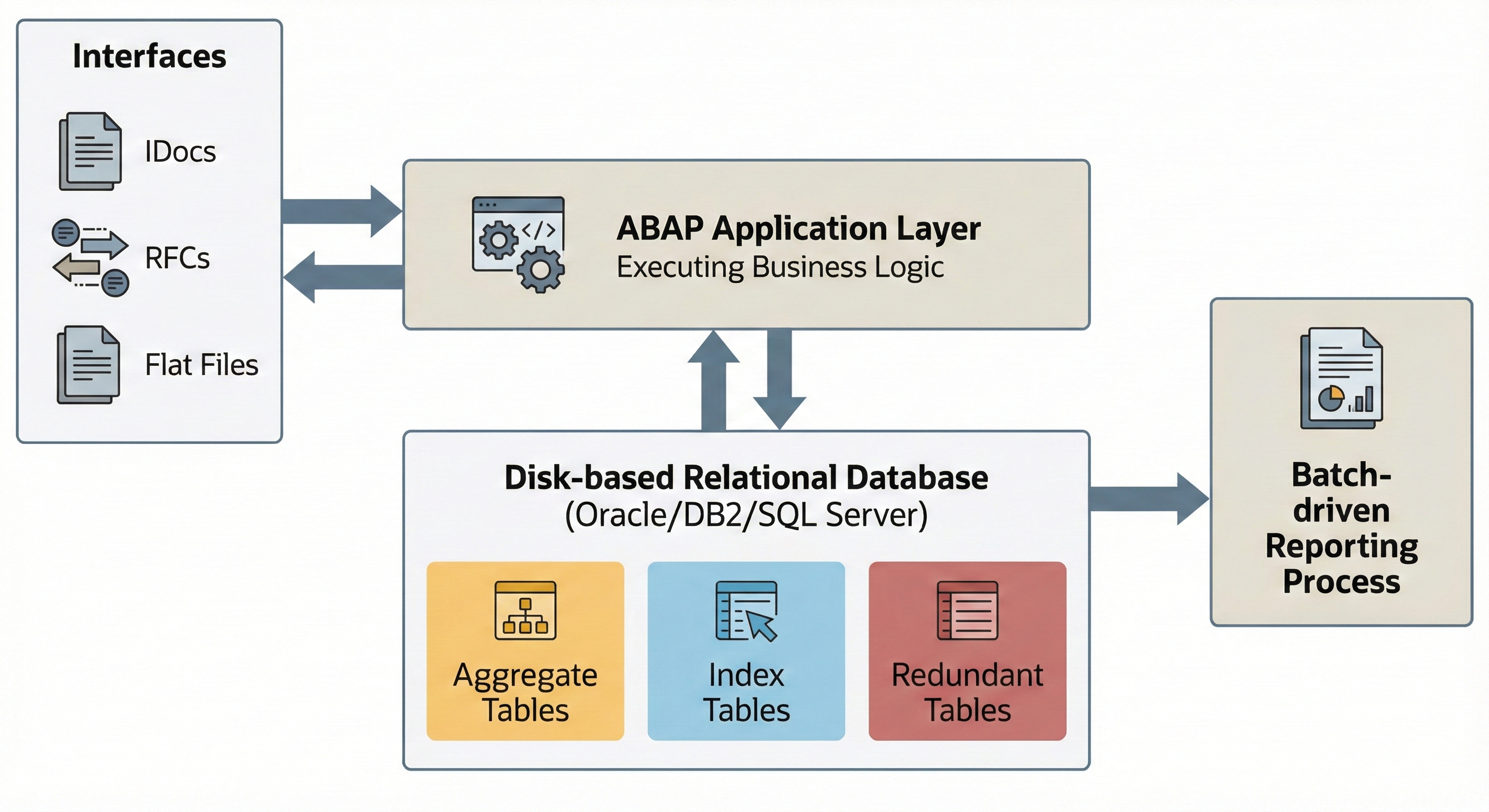
1 SAP ECC (Legacy Architecture)
- Database-agnostic (Oracle, DB2, SQL Server) - SAP ECC supports multiple databases like Oracle, IBM DB2, and Microsoft SQL Server. This flexible solution allowed enterprises to choose preferred database platforms but it also imposed technical limitations, because they now have to rely on only single solutions for any challenges occurring in their system that too depend upon the service provider.
- Disk-based storage - In SAP ECC, data is primarily stored on disk-based relational databases. Disk I/O operations are significantly slower compared to in-memory processing. To mitigate this limitation, SAP introduced complex buffering strategies and pre-calculated data structures.
- Heavy reliance on:
- Aggregate tables - To improve reporting performance, SAP ECC uses aggregate tables that store pre-summarized transactional data.
For example, instead of calculating totals dynamically, ECC reads values from aggregate tables that are periodically updated.
- Index tables - SAP ECC relies heavily on secondary index tables to speed up database searches. Since databases could not efficiently scan large datasets on disk, indexes were created to optimize frequent query paths.
- Redundant data structures - Because of aggregates and indexes, SAP ECC landscapes often contain multiple tables storing the same business data in different formats.
For example, financial data could exist across several tables for line items, totals, and reporting views.
- Application logic executed mostly at the ABAP layer - In SAP ECC, most business logic is executed in the ABAP application layer, not in the database.
- Custom programs often use:
- Nested SELECT statements
- Loop-based data processing
- Multiple database round trips
This design was necessary due to database neutrality but caused performance bottlenecks as data volumes grew. Complex calculations that could have been executed in the database were instead processed row-by-row in ABAP.
- Batch-driven reporting - Real-time analytics in SAP ECC is limited. To compensate, ECC relies on:
- Background jobs
- Periodic batch processing
- Pre-calculated totals
Reports are often based on data that is hours or days old, especially in finance and logistics.
- This batch-driven approach affects:
- Decision-making speed
- Operational visibility
- Integration with real-time external systems
2 SAP S/4HANA (Next-Gen Architecture)
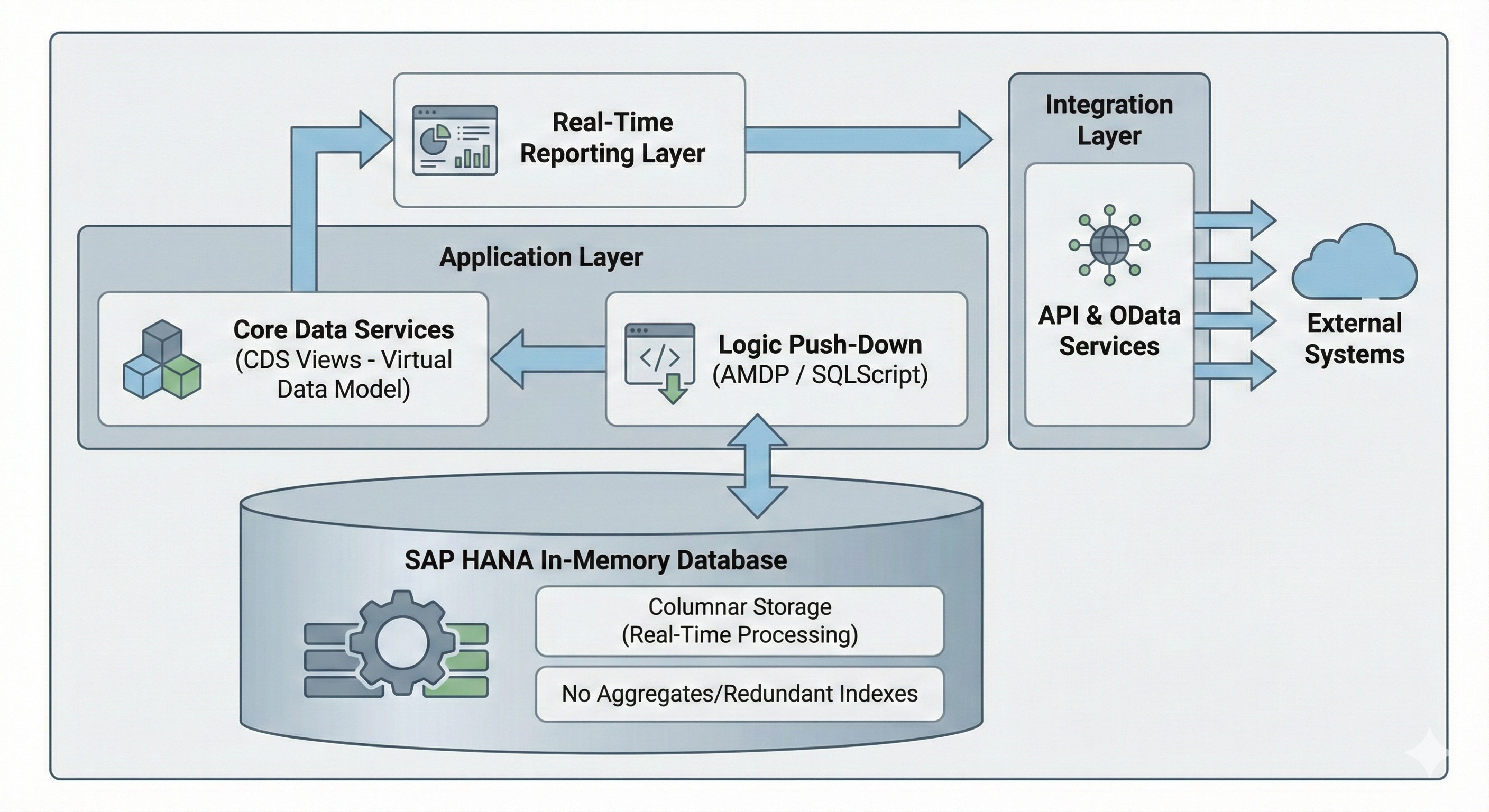
SAP S/4HANA was built from the ground up to address the structural limitations of SAP ECC. At its core, S/4HANA is designed to deliver real-time processing, simplified data models, and integration-ready architecture, enabled entirely by the SAP HANA in-memory database.
- HANA-only in-memory database - Unlike SAP ECC, which supports multiple database platforms, SAP S/4HANA runs exclusively on SAP HANA. This database dependency is intentional and foundational to S/4HANA’s capabilities.
SAP HANA stores data directly in memory (RAM) rather than reading it from disk. This eliminates I/O bottlenecks
- Columnar storage with real-time processing - SAP HANA uses columnar storage instead of traditional row-based storage.
- In columnar storage:
- Data is stored column-by-column rather than row-by-row
- Only required columns are read during queries
- Compression ratios are significantly higher
- Elimination of Aggregates - In SAP S/4HANA, traditional aggregate tables are no longer required.
Because HANA can calculate totals and summaries on-the-fly at high speed, SAP removed many pre-calculated data structures that were mandatory in ECC.
- Elimination of Redundant indices - S/4HANA significantly reduces or completely eliminates secondary index tables.
HANA’s in-memory columnar engine performs fast searches without relying on traditional indexing strategies.
- Push-down of logic to database layer - One of the most critical architectural changes in S/4HANA is the push-down of application logic to the database layer.
- Virtual data models via CDS Views - SAP S/4HANA introduces Core Data Services (CDS Views) as the foundation for its Virtual Data Model (VDM).
Impact:
Custom code, reports, and integrations designed for ECC cannot be directly reused without remediation.
Data Model Simplification: The Biggest Technical Disruption
SAP S/4HANA introduces a simplified data model, which directly affects:
- Custom programs which can be implemented easily.
- Interfaces which are user friendly and customised.
- Middleware mappings as per requirements.
- Reporting logic to make it single source of truth.
Example: Finance (FI)
| ECC | S/4HANA |
| Multiple tables (BSIS, BSAS, BSEG, GLT0) | Universal Journal (ACDOCA) |
| Reconciliation required | Single source of truth |
Integration Impact:
Any interface reading ECC tables must be redesigned to consume CDS Views or APIs.
ABAP & Custom Code: From ECC Style to HANA-Optimized Code
1) ECC ABAP Characteristics
- Nested SELECTs
- SELECT * statements
- Loop-based calculations
- Database-agnostic SQL
2) S/4HANA ABAP Expectations
- ABAP on HANA
- CDS Views
- AMDP
- SQL Script
- Push-down logic
SAP provides SPAU, SPDD, and Custom Code Migration Cockpit, but:
Tools identify issues, they don’t fix architecture.
SEPFUST Approach:
We refactor code with Clean Core principles, ensuring future-proof extensibility.
Integration Architecture: ECC vs S/4HANA
This is where most migrations fail silently.
ECC Integration Landscape
- IDocs
- RFCs
- BAPIs
- File-based interfaces
- PI/PO-centric
S/4HANA Integration Landscape
- REST & OData APIs making it easier to integrate with outside SAP integration.
- SAP Integration Suite (CPI)
- Event-based messaging making communication easy inside or outside SAP
- API-first strategy
- Side-by-side extensions on SAP BTP
Key Migration Challenge:
Legacy interfaces often:
- Break due to data model changes
- Become performance bottlenecks
- Fail compliance validations
ECC to S/4HANA Migration Paths (Technical View)
System Conversion (Brownfield)
- Existing ECC system converted
- High dependency on:
- Code remediation
- Integration redesign
- Least disruption, highest technical complexity
System Landscape Transformation
- Multiple ECC systems consolidated
- Integration harmonization required
- Ideal for large enterprises
New Implementation (Greenfield)
- Clean S/4HANA build
- Complete redesign of:
- Interfaces
- Processes
- Extensions
SEPFUST specializes in Integration-Safe Migration, regardless of approach.
Integration Challenges During Migration (Real-World Issues)
- IDoc structures deprecated or changed
- Custom Z-tables removed or replaced
- Performance degradation due to unoptimized queries
- Non-SAP system failures post go-live
- Govt portal & compliance integration breakdowns (GST, E-Invoice, ICEGATE)
This is where migrations fail, not in SAP, but in the ecosystem around SAP.
SAP Integration in S/4HANA: Best Practices
- Replace direct DB access with CDS Views
- Move point-to-point interfaces to SAP Integration Suite
- Use API-based integration
- Implement monitoring & alerting
- Decouple compliance integrations from core ERP
How SEPFUST Enables a Seamless ECC to S/4HANA Migration
SAP will end the mainstream maintenance by 31st Dec, 2027, and for older versions of ECC by December 31st, 2025. So it is very important to plan the migration before this. SEPFUST is not just a migration vendor. We are SAP Integration & Automation specialists.
What We Do Differently
Integration-First Migration Strategy
- Assess every inbound & outbound interface
- Redesign integrations for S/4HANA compatibility
- Eliminate brittle legacy connections
Custom Code & Interface Remediation
- ABAP on HANA optimization
- IDoc to API transformation
- Performance tuning for real-time processing
Govt & Compliance Integration Readiness
- E-Invoice
- E-Way Bill
- ICEGATE
- Banking & payment systems
Automation-Led Transformation
- Document automation
- Digital signature enablement
- Approval workflow modernization
Why SEPFUST for ECC to S/4HANA Migration?
- Deep SAP technical expertise
- Strong integration & automation focus
- Proven experience with compliance-critical SAP landscapes
- SAP + Non-SAP ecosystem understanding
- Post-go-live stability & performance assurance
Final Thought
ECC to S/4HANA migration is not about moving systems. It’s about redesigning how SAP interacts with your business ecosystem.
Frequently Asked Questions (FAQ)
1 Is SAP ECC to S/4HANA migration mandatory?
Yes. SAP has announced the end of mainstream maintenance for ECC, making migration unavoidable for long-term compliance and innovation.
2 What is the biggest technical difference between SAP ECC and SAP S/4HANA?
The shift to an in-memory HANA database, simplified data models, and API-driven integration architecture.
3 Do integrations need to be rebuilt during S/4HANA migration?
In most cases, yes. ECC-style integrations using direct table access or legacy IDocs require redesign.
4 How does SEPFUST help in ECC to S/4HANA migration?
SEPFUST focuses on integration-first migration, ensuring all SAP and non-SAP systems work seamlessly post-migration.
A successful SAP ECC to S/4HANA migration is not just a technical upgrade—it is a strategic integration transformation. With SEPFUST’s deep expertise in SAP integration, automation, and compliance, enterprises can migrate with confidence and future readiness.

Rishi Raj
Rishi Raj is a marketing professional with strong domain expertise in Finance and Technology, bringing over 3+ years of experience in driving growth-led marketing initiatives. He has a proven track record in building scalable go-to-market strategies, demand generation, and positioning technology products for measurable business impact.