

For any business involved in international trade the export documentation is the backbone, and among all the documents Shipping Bill plays a critical role. Every exporter dealing with Indian Customs via ICEGATE must understand shipping bills, not just for compliance, but also for GST refunds, drawback claims, and export incentives.
In this blog we will cover the important aspects like what a shipping bill is, type of shipping bill, process of filling, and how businesses can automate shipping bill & bill of entry data extraction using SEPFUST’s AI-powered readers.
What is a Shipping Bill?
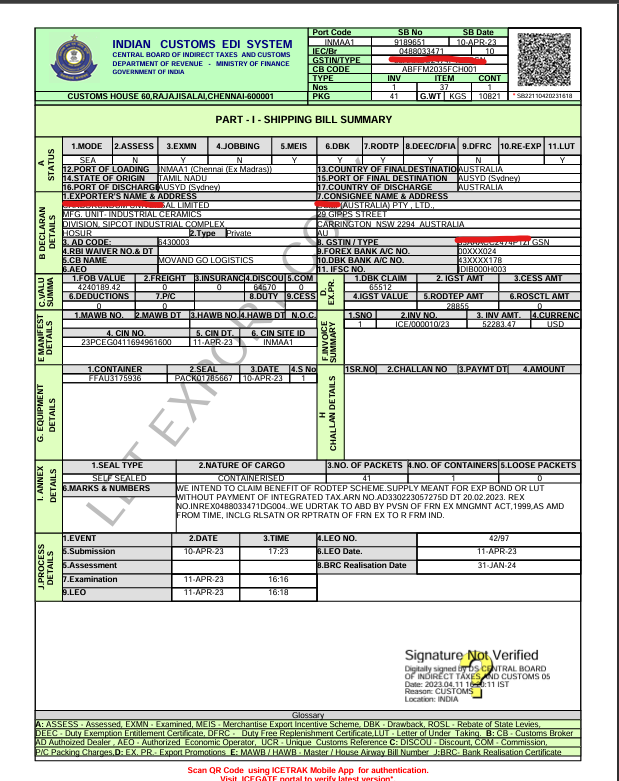
A Shipping bill is a Legal document required for exporting goods, it is filed by an exporter or custom broker on the behalf of the exporter with Indian Customs through ICEGATE. It authorizes the export of goods from India and contains complete shipment details such as:
- Exporter & Consignee details
- HSN codes and product description
- Invoice and FOB value
- Port of loading
- Export incentives claimed (Drawback, RoDTEP, etc.)
Without a Shipping Bill, goods cannot be exported legally.
Why is the Shipping Bill Important in Export?
Shipping Bills are required for:
- Customs clearance
- GST Refund processing
- Duty Drawback claims
- RoDTEP / MEIS benefits
- FEMA and RBI reporting
- Audit and reconciliation with GSTR-1 & ICEGATE data
Any mismatch in Shipping Bill data can delay refunds or trigger notices.
Types of Shipping Bills in India
Indian Customs classifies shipping bills into the following categories:
1. Free Shipping Bill
- Used when no export incentive is claimed
- Mainly for non-incentivized exports
2. Drawback Shipping Bill
- Filed when exporter claims duty drawback
- Requires accurate duty and tax details
3. EPCG Shipping Bill
- Filed under Export Promotion Capital Goods Scheme
- Subject to export obligation compliance
4. DEPB / Incentive Shipping Bill
- Used for exports under government incentive schemes like RoDTEP
Each type demands precise data accuracy, making automation critical.
Shipping Bill Format PDF– Key Fields Explained
A typical Shipping Bill PDF contains:
- Shipping Bill Number & Date
- IEC Code
- GSTIN
- Port Code
- Invoice No & Date
- FOB Value
- Currency
- HSN Codes
- Drawback / Incentive Details
Manually extracting this data from hundreds of PDFs is time-consuming and error-prone.
Manual Challenges Faced by Exporters & Finance Teams
Most exporters face issues such as:
- Manual data entry from ICEGATE PDFs
- Errors in HSN, FOB values, or invoice matching
- Delay in GST refunds
- Difficulty in reconciling with GSTR-1 & books
- No ERP integration
This is where SEPFUST Shipping Bill Reader comes in.
Automate Shipping Bill Data Extraction with SEPFUST
SEPFUST offers an AI-powered Shipping Bill Reader that extracts structured data directly from ICEGATE Shipping Bill PDFs.
Key Benefits:
- Automated reading of Shipping Bill PDFs
- Extracted 350+ key fields accurately
- Supports bulk uploads
- Export data to Excel / SAP / Oracle
- Ready for GST refund & reconciliation workflows
👉 Try now: Shipping Bill Data Extraction Tool
(replace with your actual shipping bill tool URL if different)
What is a Bill of Entry (BOE) & How It Differs from Shipping Bill?
| Aspect | Shipping Bill | Bill of Entry |
| Used for | Export | Import |
| Filed by | Exporter | Importer |
| Customs Purpose | Export clearance | Import clearance |
| ICEGATE Filing | Yes | Yes |
Many companies deal with both exports and imports, making dual automation essential.
SEPFUST BOE Reader – Import Data Made Easy
SEPFUST’s Bill of Entry Reader automatically extracts:
- BOE No & Date
- Importer Details
- Assessable Value
- IGST, BCD, SWS
- Port & CHA details
Explore here: Bill of Entry Extraction Tool
Shipping Bill + BOE Automation = Complete Trade Compliance
When Shipping Bill & BOE data is automated together, companies gain:
- Accurate GST reconciliation
- Faster refund processing
- Audit-ready records
- ERP-ready structured data
- Zero manual dependency
SEPFUST integrates seamlessly with SAP, Oracle, and custom ERPs.
Why Choose SEPFUST for Trade Document Automation?
- ICEGATE-specific parsing logic
- AI + OCR powered extraction
- Bulk processing capability
- SAP & Oracle ERP integration
- Used by exporters, importers & logistics companies
👉 Book a demo: Contact SEPFUST
Final Thoughts
In today’s world of business where global expansion is happening and exports are rising, the business handling manually shipping bills is no longer sustainable. Automation reduces the efforts and accelerates the process, improves compliance, and enables data-driven decision-making.
If you’re dealing with ICEGATE Shipping Bills or Bills of Entry, SEPFUST offers the most reliable automation solution in the market.
👉 Start automating today [Book A Demo]
FAQs on Shipping Bill in Export (SEO Optimized)
1. What is a Shipping Bill for export?
A Shipping Bill is a legal customs document filed for exporting goods from India through ICEGATE.
2. Who files the Shipping Bill?
Exporters or their authorized Customs House Agents (CHA) file it online.
3. Is Shipping Bill required for GST refund?
Yes, Shipping Bill data is essential for processing GST refunds on exports.
4. Can Shipping Bill data be automated?
Yes, tools like SEPFUST Shipping Bill Reader automate data extraction from PDFs.
5. What is the difference between Shipping Bill and Bill of Entry?
The Shipping Bill is for exports, while the Bill of Entry is for imports.
SEPFUST builds AI-powered automation solutions for trade, finance, tax, and supply chain. We specialize in Shipping Bill and Bill of Entry data extraction with seamless ERP integration.

Rishi Raj
Rishi Raj is a marketing professional with strong domain expertise in Finance and Technology, bringing over 3+ years of experience in driving growth-led marketing initiatives. He has a proven track record in building scalable go-to-market strategies, demand generation, and positioning technology products for measurable business impact.