

The world is rapidly evolving and the digital landscape is changing continuously, due to which enterprise systems need to provide real-time insights, high scalability, and simplified operations. SAP's next-generation ERP suite SAP S/4HANA is designed to meet these demands. Unlike its predecessor, SAP ECC, S/4HANA is built on a modern in-memory database, offering businesses unparalleled performance and flexibility.
In this blog we will be understanding the deeper side of SAP S/4 HANA.
1. What is SAP HANA In-Memory Database?
At the core of SAP S/4HANA is SAP HANA, an in-memory, columnar database. This architecture eliminates the need for traditional disk-based storage during transactional processing, allowing for real-time analytics and transactional processing (OLAP + OLTP) on the same system.
Key Architectural Advantages:
- Simplified Data Model: SAP HANA reduces the number of tables, aggregates, and indices, making the data model leaner and faster.
- Real-Time Analytics: Organizations can generate reports and dashboards instantly, without relying on separate data warehouses.
- Performance Boost: In-memory computing significantly reduces latency, making processes like order-to-cash, procure-to-pay, and financial closing faster.
Use Case: A global manufacturing company adopted S/4HANA to consolidate its regional ERP systems. Using the in-memory architecture, it reduced month-end financial closing from 12 days to 2 days, showcasing the real-world impact of the database-centric design.
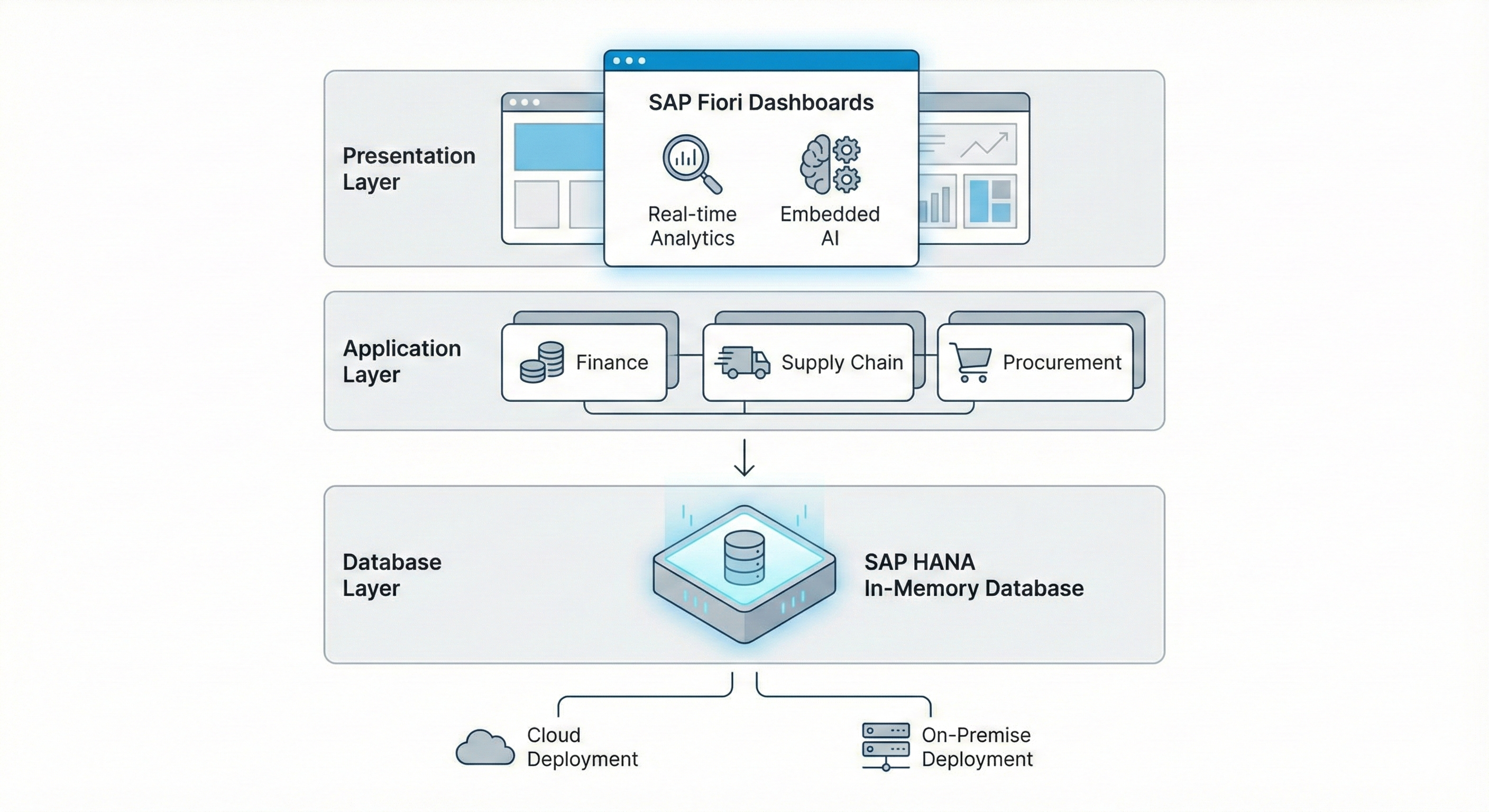
2. What Are The Three Layers in SAP S/4HANA Architecture?
Unlike SAP ECC, which relied heavily on separate application servers and batch processing, S/4HANA is built on a simplified, modern architecture:
a) Presentation Layer
- User Interface: SAP Fiori provides a role-based, responsive, and intuitive UI that works across devices.
- Benefits: Users no longer need multiple screens or complex navigation; business processes can be executed through dashboards and apps.
Analysis: The Fiori-based presentation layer significantly improves user adoption. Case studies show companies see a 20–30% increase in productivity simply by enabling role-based Fiori apps.
b) Application Layer
- Core Business Logic: S/4HANA processes are streamlined using ABAP Managed Database Procedures (AMDP) and Core Data Services (CDS).
- Integrated Modules: Finance, Supply Chain, Manufacturing, Procurement, Sales, and HR modules operate on a single unified platform.
Insight: The tight integration reduces data redundancy and inconsistencies. In a case study from the retail sector, integration of procurement and inventory modules reduced stock-outs by 15% while improving procurement cycle time by 25%.
c) Database Layer
- SAP HANA Database: The in-memory database supports both row-based and columnar storage.
- Advanced Analytics: Embedded predictive analytics, machine learning, and IoT processing capabilities are native to HANA.
Use Case: An automotive company leveraged predictive analytics in S/4HANA to forecast spare parts demand, reducing excess inventory by 18% and preventing production delays.
3. Deployment Architecture Options
SAP S/4HANA can be deployed in multiple ways, giving enterprises flexibility depending on their IT strategy:
- On-Premise: Full control over infrastructure, suitable for companies with strict compliance needs.
- Cloud (SaaS): Rapid deployment, reduced maintenance, and scalable resources.
- Hybrid: Combines on-premise and cloud deployment for selective modules.
Analysis: Companies in regulated industries like pharmaceuticals or finance often prefer on-premise deployment for control, while e-commerce or startups lean toward cloud solutions for scalability and lower TCO.
4. Advanced Architecture Features
a) Embedded Analytics
S/4HANA eliminates the need for separate BI tools for operational reporting. Key metrics are available in real-time through CDS views and analytical apps.
Example: A logistics company integrated embedded analytics to monitor fleet utilization. Real-time dashboards improved operational efficiency and reduced fuel costs by 12%.
b) Simplified Data Model
- Reduces table count (e.g., finance tables reduced from 40+ in ECC to fewer than 10 in S/4HANA).
- Removes aggregates and indices, improving data retrieval speed.
Impact: Simplified data models accelerate financial processes and reporting cycles, enabling faster decision-making.
c) Extensibility
S/4HANA provides flexible extensibility via the SAP Cloud Platform and Side-by-Side Extensions. Businesses can build custom applications without affecting the core system.
Use Case: A consumer goods company added a custom IoT-driven inventory tracking module as a side-by-side extension, enabling predictive restocking without disrupting standard SAP processes.
5. Integration and Interoperability
SAP S/4HANA is designed to integrate seamlessly with:
- SAP Products: SAP Ariba, SAP SuccessFactors, SAP Concur.
- Third-Party Systems: Banking portals, government compliance systems, CRM tools.
- APIs & Cloud Services: OData, REST APIs, and SAP Integration Suite enable real-time communication.
Analysis: Integration capabilities make S/4HANA a true digital core. In practice, organizations can synchronize finance, procurement, and supply chain in real time, reducing operational silos.
6. Real-World Case Study
Company: Global Manufacturing Enterprise
Challenge: Legacy SAP ECC systems caused delayed reporting, fragmented supply chain visibility, and inefficient financial operations.
Solution: Migration to SAP S/4HANA with Fiori UI, embedded analytics, and simplified data models.
Results:
- Financial closing reduced from 12 days to 2 days.
- Real-time inventory tracking led to a 20% reduction in excess stock.
- Procurement cycle time improved by 25%, increasing vendor satisfaction.
This demonstrates how S/4HANA’s architecture directly translates into tangible business benefits.
7. Conclusion
SAP S/4HANA’s architecture is more than a technological upgrade, it is a strategic enabler for digital transformation. By leveraging the in-memory HANA database, simplified data models, integrated modules, and real-time analytics, organizations can achieve operational excellence and make faster, data-driven decisions.
For businesses navigating digital complexity, understanding S/4HANA’s architecture is the first step toward unlocking agility, efficiency, and innovation. Whether deployed on-premise, in the cloud, or as a hybrid model, S/4HANA provides the foundation for a connected, intelligent enterprise.
SEPFUST Expertise: At SEPFUST, we specialize in SAP automation, integration, and digital transformation services. From S/4HANA migration strategies to SAP digital cockpits, we help enterprises unlock the full potential of SAP systems while reducing complexity and maximizing ROI.
SEPFUST empowers enterprises with SAP automation, integration, and digital transformation solutions, enabling real-time insights, simplified processes, and optimized business operations.

Rishi Raj
Rishi Raj is a marketing professional with strong domain expertise in Finance and Technology, bringing over 3+ years of experience in driving growth-led marketing initiatives. He has a proven track record in building scalable go-to-market strategies, demand generation, and positioning technology products for measurable business impact.