

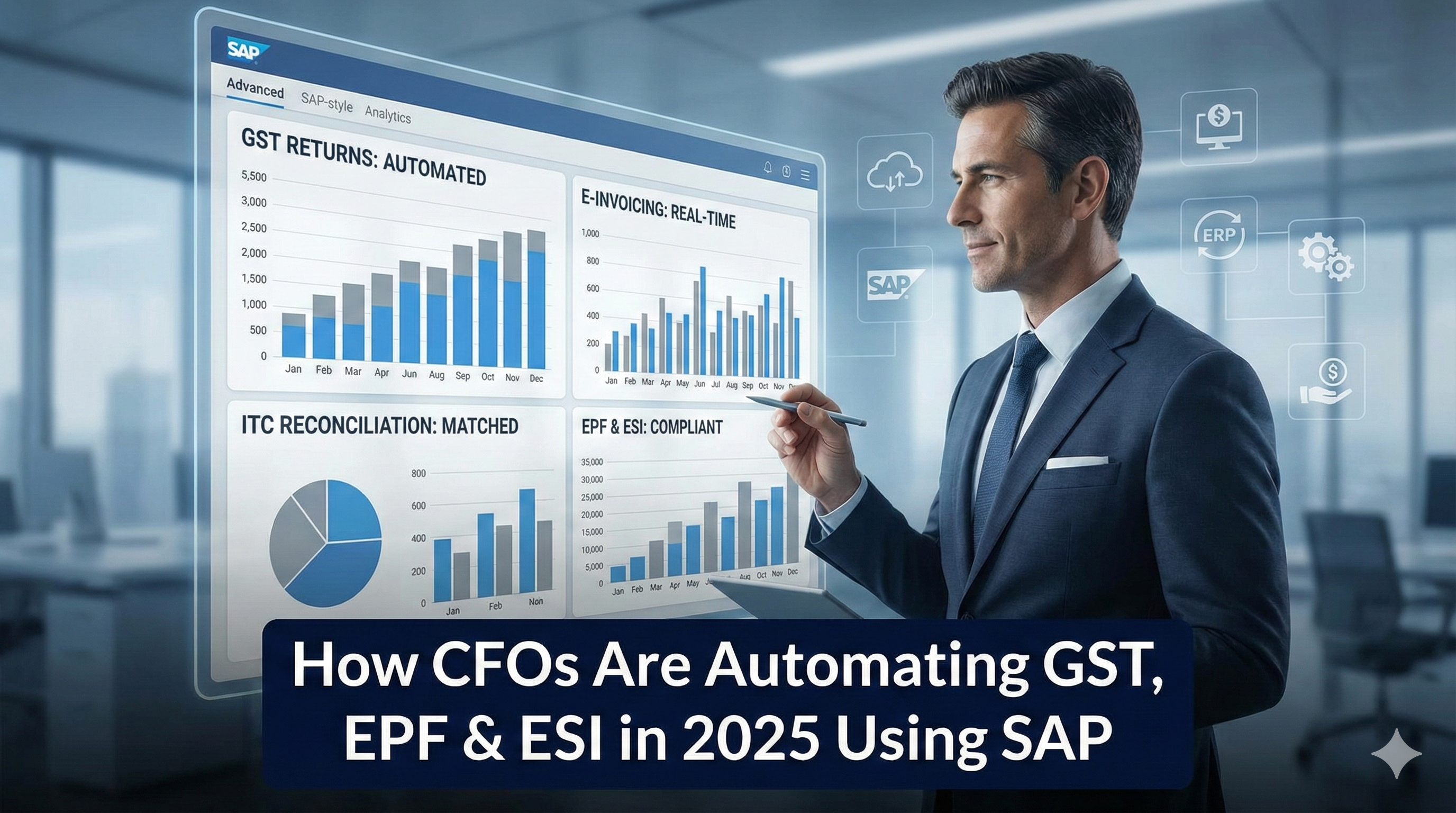
The Evolving Compliance Landscape for CFOs in 2025
In 2025 Chief Financial Officers are dealing with a lot of rules they have to follow. These rules are getting tougher because of changes in taxes and new laws. Chief Financial Officers have to do a lot of things to follow these rules like dealing with Goods and Services Tax, Employee Provident Fund and Employee State Insurance. So Chief Financial Officers think it is very important to use computers to help with these tasks. This will help them manage money better and make their work easier. Chief Financial Officers want to automate tax and regulatory tasks to make their job simpler. They have to handle Goods and Services Tax and other things, like Employee Provident Fund and Employee State Insurance.
Manual processes not only consume significant time but also expose organizations to errors, audit penalties, strained resources, and slower financial close cycles. As a result, forward-looking CFOs are turning to enterprise technology platforms like SAP to embed automation, improve accuracy, achieve real-time visibility, and reduce risk.
Why SAP Is the Centerpiece of Compliance Automation
SAP’s suite of products, especially SAP S/4HANA, SAP Document and Reporting Compliance, SAP Financial Management, and SAP Payroll solutions, provides CFOs with the ability to unify finance, tax, HR, and statutory compliance under one digital framework.
1). GST Automation
SAP automates GST compliance by integrating transactional data with GST reporting workflows, enabling real-time or near-real-time filing preparation, automatic tax calculation, and reconciliation.
- Real-time data integration with GSTN: Automated extraction and validation of invoices, tax codes, and Input Tax Credit (ITC) details helps reduce manual reconciliation and improves accuracy.
- E-invoicing & return automation: With SAP, organizations can automatically generate e-invoices, validate them against GST rules, and prepare returns (GSTR-1, GSTR-3B, etc.) directly from ERP systems.
- Centralized reporting and audit trails are really important. This is because every single GST transaction can be traced. This helps a lot when it comes to audits and governance reviews as it reduces the risk. With reporting and audit trails for GST transactions people can see what is going on which is very useful, for GST transactions. These embedded features reduce manual burden, cut turnaround times, and improve compliance readiness.
Note: SAP continues to evolve compliance services, recently indicating that older Digital Compliance Services will be deprecated by December 2027, with newer reporting mechanisms via SAP S/4HANA and Document and Reporting Compliance filling the gap.
2). EPF, ESI & Payroll Compliance Automation
While SAP automates GST at the tax level, payroll tax and statutory deductions such as EPF and ESI are automated through SAP’s HR and Payroll solutions, including:
- SAP Payroll (core on SAP S/4HANA or SAP HCM): Automates payroll runs with statutory deductions (PF, ESI, TDS, etc.) based on configured wage types and statutory parameters.
- Integration with HR Master Data: Employee records (e.g., wage, state codes, PF/ESI eligibility) are managed centrally, ensuring statutory computations are based on up-to-date information.
- Localized statutory compliance: Systems can incorporate country- or state-specific rules for accurate deduction and reporting.
- These features ensure accurate calculation, timely statutory payments, and compliance reporting without resorting to spreadsheets or external tools.
The Strategic Value of Automation for CFOs
Time and Cost Efficiency
Automation dramatically reduces the hours spent on manual tasks such as data collection, verification, form preparation, and error-checking. Finance and HR teams can instead focus on forecasting, analytics, and strategic planning.
Real-Time Visibility and Risk Reduction
With compliance logic embedded in SAP, CFOs gain real-time dashboards and alerts that highlight risks, such as mismatched invoices, pending statutory filings, or compliance gaps, well before deadlines. This enables proactive governance and reduced penalty risk.
Enhanced Audit Readiness
Automated audit trails and trace-back capabilities mean that every tax return (GST) or statutory contribution (EPF/ESI) can be supported with a clear data lineage, accelerating internal and statutory audits.
Challenges CFOs Face in 2025
Even with automation, CFOs must navigate:
- Frequent regulatory changes (e.g., GST reform updates or ISD mechanisms for ITC distribution) that require systems to be updated promptly.
- Integration gaps when SAP systems are not fully configured or connected to external tax portals.
- Quality of master data, especially for tax classifications, employee data, or vendor GSTINs.
These challenges, however, provide opportunities for specialized tools and platform enhancements.
Introducing SEPFUST: Your Strategic Automation Companion
SEPFUST is designed to complement and extend the compliance automation capabilities CFOs achieve with SAP. Here’s how it fits into the automation journey:
Seamless Integration with SAP
SEPFUST integrates with your SAP environment to automate compliance processes across GST, EPF, and ESI. It extracts data directly from SAP modules such as Finance (FI), Controlling (CO), and HR/Payroll, minimizing manual extraction or data reconciliation.
End-to-End Statutory Compliance
From calculating GST liabilities and preparing returns to computing workforce tax deductions (EPF and ESI), SEPFUST streamlines the entire workflow, ensuring legal compliance and reducing error rates.
Real-Time Monitoring & Alerts
SEPFUST continuously monitors compliance metrics and sends proactive alerts for discrepancies, such as mismatched GST credits, late filings, or statutory contribution gaps, empowering CFOs to act before issues escalate.
Regulatory Updates & Intelligent Rules Engine
With constantly updated compliance rules, SEPFUST can adapt automatically to changes in GST laws, PF rates, or ESI thresholds. This keeps your SAP business processes insulated from evolving statutory risk exposure.
Comprehensive Reporting & Analytics
SEPFUST offers CFO-grade dashboards and reports, summarizing compliance status, financial impact of statutory contributions, and trends over time, allowing finance leaders to make informed decisions quickly.
Audit & Documentation Support
With an integrated repository of compliance logs, reports, and supporting documents, SEPFUST makes audits faster and less resource-intensive—whether internal or government-led.
Best Practices for CFOs in 2025
Embed compliance logic at the transaction entry point, not just at reporting time.
Utilize real-time integration between SAP and statutory portals (e.g., GSTN).
Automate reconciliations, so mismatches in GST ITC, EPF/ESI deductions are flagged instantly.
Standardize master data governance to ensure accurate tax classification and deduction rules.
Invest in dashboarding and alerting via solutions like SEPFUST for actionable insights.
Conclusion
In 2025, CFOs are emphatically moving beyond manual compliance to a data-driven, automated framework powered by SAP and strategic automation platforms like SEPFUST. This transformation:
- Accelerates tax and statutory filings
- Minimizes risk of errors and penalties
- Enables real-time visibility across finance and HR compliance processes
- Elevates finance teams to strategic value drivers beyond routine compliance work
Whether your enterprise is already on SAP S/4HANA, using payroll modules, or planning to modernize compliance in a cloud-first environment, combining SAP’s robust automation capabilities with SEPFUST’s intelligence can help you meet compliance requirements confidently, scale efficiently, and power strategic decision-making.
FAQs: Automating GST, EPF & ESI Using SAP in 2025
1. Why is compliance automation critical for CFOs in 2025?
In 2025, regulatory requirements for GST, EPF, and ESI are more stringent and data-driven. Automation helps CFOs reduce errors, avoid penalties, improve audit readiness, and gain real-time visibility into compliance status.
2. How does SAP help automate GST compliance?
SAP automates GST by integrating transactional data with tax calculation, e-invoicing, return preparation, and reconciliation processes. It enables real-time invoice validation, ITC matching, and automated generation of GSTR-1 and GSTR-3B.
3. Can SAP handle EPF and ESI compliance automatically?
Yes. SAP Payroll and HR modules automate EPF and ESI calculations using configured wage types, employee master data, and statutory parameters, ensuring accurate deductions and timely statutory reporting.
4. What challenges do CFOs face even after implementing SAP?
Common challenges include frequent regulatory changes, incomplete SAP-GST portal integration, master data inconsistencies, and limited real-time compliance monitoring, which may still require manual intervention.
5. How does SEPFUST complement SAP for compliance automation?
SEPFUST extends SAP by adding intelligent automation, real-time alerts, automated reconciliations, regulatory rule updates, and CFO-ready dashboards for GST, EPF, and ESI compliance.
6. Does SEPFUST integrate with SAP S/4HANA and SAP Payroll?
Yes. SEPFUST integrates seamlessly with SAP S/4HANA, SAP FI, CO, and HR/Payroll modules to extract data directly and automate statutory compliance workflows without disrupting core ERP processes.
7. How does automation improve audit readiness?
Automation creates complete audit trails, traceable transaction histories, and centralized documentation. This enables faster audits, reduces dependency on manual data collation, and minimizes compliance risks.
8. Can SEPFUST adapt to changes in GST, EPF, and ESI laws?
Yes. SEPFUST features an intelligent rules engine that is continuously updated to reflect changes in GST regulations, EPF rates, and ESI thresholds, ensuring ongoing compliance without manual reconfiguration.
9. Is compliance automation suitable for mid-sized enterprises using SAP?
Absolutely. Both SAP and SEPFUST are scalable and suitable for mid-sized and large enterprises seeking to reduce compliance workload, improve accuracy, and enhance governance.
10. What are the key benefits CFOs gain from automating compliance?
CFOs benefit from reduced compliance costs, faster close cycles, real-time risk visibility, improved governance, and the ability to shift finance teams from routine compliance tasks to strategic initiatives.
SEPFUST enhances SAP compliance automation by streamlining GST, EPF, and ESI workflows. It delivers real-time monitoring, automated reconciliations, regulatory updates, and audit-ready reporting for modern CFOs.

Rishi Raj
Rishi Raj is a marketing professional with strong domain expertise in Finance and Technology, bringing over 3+ years of experience in driving growth-led marketing initiatives. He has a proven track record in building scalable go-to-market strategies, demand generation, and positioning technology products for measurable business impact.