

A GST scrutiny notice landing in your inbox can rattle any finance team. But here's the thing: under the GST framework, the department runs this as a routine, non-intrusive verification exercise to make sure the data adds up.
A scrutiny notice doesn't automatically mean someone's accusing you of tax evasion. It's a look into data discrepancies, nothing more. Once you understand how these notices work, especially the ones issued under Section 61 of the CGST Act, and respond carefully, you can steer clear of penalties, interest, or the whole thing escalating into a full audit under Section 65.
This guide walks through the technical grounds for scrutiny, the workflow from Form ASMT-10 through to ASMT-12, and how automation can take some of the load off your compliance work.
What Is Scrutiny Notice?
A GST scrutiny notice is a formal communication from the appropriate officer, sent to verify whether the returns a registered person filed are accurate. Section 61, read alongside Rule 99 of the CGST Rules, 2017, governs how this works.
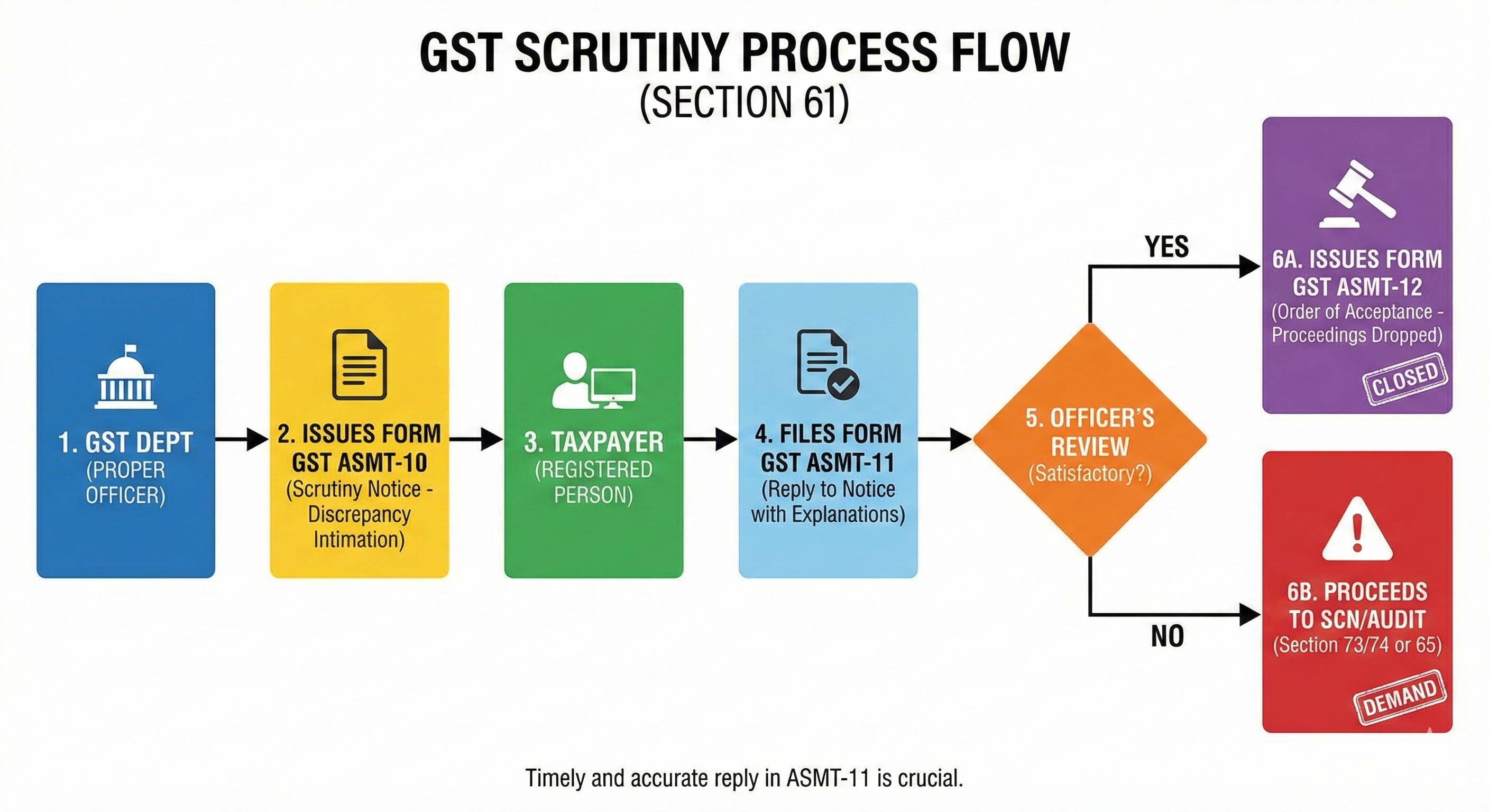
Say the officer spots a discrepancy, maybe the declared liability doesn't match the tax actually paid. At that point they issue Form GST ASMT 10. The notice lays out what the discrepancies are and asks the taxpayer to either explain them or pay up the differential tax along with interest.
The goal is preliminary verification. If the response is satisfactory, the case is dropped. If not, the case may proceed to a demand notice under Sections 73 (non-fraud cases) and 74 (fraud cases).
Technical Triggers: Why Are Scrutiny Notices Issued?
In the current digital tax administration, the GSTN portal uses Advanced Analytics and Artificial Intelligence to detect inconsistencies. Notices are rarely generated at random; rather, they are triggered by specific data points.
1. Output Tax Mismatch (GSTR-1 vs. GSTR-3B)
The most common trigger is a discrepancy between the liability declared on GSTR-1 (Outward Supplies) and GSTR-3B (Summary Return).
- Technical Example: If you declare a taxable turnover of ₹10 Lakhs in GSTR-1 but pay tax on only ₹8 Lakhs in GSTR-3B, the system flags this short payment immediately.
2. ITC Mismatches (GSTR-3B vs. GSTR-2A/2B)
Excessive Input Tax Credit (ITC) claims are a key focus. If the ITC claimed in Table 4(A)(5) of GSTR-3B is greater than the ITC available in the auto-populated GSTR-2B statement, there is cause for concern.
3. HSN and Rate Classification Errors
Officers review the HSN codes reported to ensure that the correct tax rate is used.
- Technical Example: If a business supplies "Automotive Parts" taxable at 28% but uses an HSN code attracting 18%, this discrepancy in the rate of tax will trigger an inquiry.
4. Ineligible ITC and Blocked Credits
Claiming ITC on goods or services prohibited by Section 17(5) (for example, food and beverages, personal use vehicles) is frequently scrutinized if discovered during data analysis.
5. E-Way Bill vs. GSTR-1 Variance
Significant differences between the turnover projected via active E-Way Bills and the turnover reported in GSTR-1 indicate that sales may be underreported.
How to Reply to a GST Scrutiny Notice (Step-by-Step)
Form ASMT-10 requires a structured, evidence-based approach. The response is submitted using Form GST ASMT-11.
Step 1: Analyze the Notice (ASMT-10)
Look closely at the "Discrepancy Parameter." Is it a tax rate issue, a turnover discrepancy, or an ITC flag? Take note of the fiscal year and the reply deadline (usually 30 days).
Pro Tip: For businesses receiving multiple notices across different GSTINs, manual tracking is risky. Using a GST Notice Extractor can help you instantly capture notice details from the portal and assign them to the relevant team members for action.
Step 2: Perform Data Reconciliation
Before drafting a reply, you must validate the data.
- For Turnover: Reconcile GSTR-1 Table 4 with GSTR-3B Table 3.1 and your Audited Financials.
- For ITC: Reconcile GSTR-3B Table 4 with GSTR-2B and your Purchase Register.
- Technical Example: If the mismatch is due to an invoice reported by a vendor in a later month, identify that specific transaction ID to prove that ITC was validly claimed when it appeared in GSTR-2B.
Step 3: Draft the Reply (Form ASMT-11)
Your reply must be factual and legal.
- If you agree with the discrepancy: Pay the tax, interest (Section 50), and penalty (if applicable) via Form DRC-03.
- If you disagree: Provide a point-wise explanation. Attach reconciliation sheets, sample invoices, and legal precedents if necessary.
Step 4: Submission and Closure (Form ASMT-12)
Submit the reply on the GST Portal. If the officer finds the explanation acceptable, they will issue an order in Form GST ASMT-12, signifying that the scrutiny proceedings are dropped.
The Role of Automation in Handling Scrutiny
Manual reconciliation of scrutiny responses is error-prone, especially when dealing with thousands of line items. Modern tax teams rely on automation to ensure accuracy and speed.
1. Automated Data Extraction
Logging into the portal to check for notices every day is inefficient. An automated system can collect notices, sort them by urgency, and notify stakeholders.
2. Intelligent Reconciliation
To defend ITC claims, you need a robust reconciliation history. Tools that offer Auto ITC Reconciliation allow you to match your purchase register with GSTR-2B in real-time, identifying missing
invoices or vendor errors before the department flags them.
3. Vendor Compliance Management
Many notices stem from non-compliant vendors who fail to file returns. Using a Verify GSTIN Tool during vendor onboarding ensures you only deal with compliant suppliers, significantly reducing downstream mismatches.
For organizations handling multiple GST registrations and notices, Sepfust GST Notice Management can help centralize notice tracking, document management, assignments and response follow-ups.
Consequences of Ignoring a Scrutiny Notice
Failure to reply to Form ASMT-10 or providing an unsatisfactory explanation has serious legal implications:
- Demand Order: The officer may initiate proceedings under Section 73 or 74, issuing a Show Cause Notice (SCN) in Form DRC-01.
- Audit: Persistent discrepancies may trigger a departmental audit under Section 65.
- Interest & Penalties: Interest under Section 50 accumulates daily. Delayed action increases the financial burden significantly.
Final Thoughts: Moving from Reactive to Proactive
GST scrutiny notices are a necessary part of the compliance process. The key to managing them is not only a good response, but also a proactive data strategy. Businesses that maintain "audit-ready" data through continuous reconciliation and automated notice management are far better positioned to deal with scrutiny confidentially.
Using spreadsheets to manage large GST datasets is a liability. Adopting an AI-enabled compliance system guarantees that when the department asks a question, you will have an immediate, accurate response.
Sepfust Solutions provides tax and finance automation for SAP & Oracle ERPs. Their "Smart Cockpit" add-ons—including Auto-ITC Reconciliation, GST Notice Extractor, and E-Invoicing—integrate directly with government APIs, eliminating manual errors and external portal dependency for seamless compliance.

Kunal Jaitly
Kunal Jaitly is a seasoned Tax-Technology leader with over 20+ years of experience spanning Taxation, Finance, and ERP-driven automation. With a strong Big 4 consulting background, Kunal has led and delivered large-scale tax and compliance transformation programs for enterprises across industries.
As the Founder of SEPFUST, he brings deep domain expertise and a practitioner’s mindset to building SAP-native and cloud-based automation solutions that simplify compliance, enhance accuracy, and unlock the true potential of enterprise systems. His work bridges the gap between complex tax regulations and scalable technology, enabling organizations to move from manual processes to intelligent automation.