

ITC, from being a transactional benefit to compliance-driven entitlement, has evolved continuously, just as India's GST law does. It was very recently that an Invoice Management System, or IMS, came into existence, which basically altered how recipients interact with supplier invoices and how the eligibility of ITC is determined.
From the FY 2024–25 onwards, the GST IMS reconciliation is not an option. It is a statutory control mechanism that impacts directly:
- Availability of ITC
- GSTR-2B locking
- Vendor compliance ratings
- Audit exposure and litigation risk
For organizations already on SAP ERP, manual reconciliation is not scalable. This is where SAP-based GST Cockpits like SEPFUST's IMS Automation become critical.
This blog explains GST IMS reconciliation from a law, compliance, accounting, and SAP automation perspective.
What Is IMS In GST?
The Invoice Management System(IMS) is a Functionality given to the taxpayers by GSTN to allow taking actions on invoices uploaded by their suppliers in GSTR-1 / IFF before such invoices flow into GSTR-2B.
Key Goal of IMS
Providing the beneficiaries with control of the ITC through the facility of taking invoice-level actions prior to the credit crystallization.
What Actions are Available to the Recipient under the IMS?
A recipient can:
- Accept an invoice → Eligible for ITC
- Reject invoice → Ineligible (Incorrect GSTIN, fake bill, etc.)
- Keep Pending → Temporarily blocked until clarified
After being acted upon, these invoices impact the final ITC to be displayed in GSTR-2B.
Legal Framework Governing GST IMS Reconciliation
Relevant Sections & Rules
Section 16 of CGST Act, 2017
ITC is available only if:
- Tax invoice is valid
- Goods/services are received
- Tax is paid to the Government
- Return is furnished
IMS operationalizes Section 16(2) by validating supplier compliance upfront.
Rule 36(4) of The CGST Rules
- ITC restricted to invoices appearing in GSTR-2B
- IMS ensures only accepted invoices flow to 2B
Section 38 – Communication of ITC
- IMS is the mechanism of communication and confirmation of ITC between supplier and recipient.
IMS Reconciliation vs Traditional GSTR 2B Reconciliation
| Traditional 2B Reco vs IMS Reco | ||
| Timing | Post-credit | Pre-credit |
| Control | Reactive | Proactive |
| Vendor errors | Detected later | Blocked early |
| ITC reversals | Frequent | Minimised |
| Audit risk | High | Significantly lower |
"The IMS reconciliation process is therefore a form of preventive, not corrective
Real-life Scenarios for GST IMS Reconciliation
On the practical side from a CA’s experience, the following issues are faced by the enterprises:
1. Volume of Invoices
In fact, for large entities, thousands of invoices are handled monthly for different plants, GSTINs, and suppliers.
2. Errors in Supplier Master Data
Incorrect GSTIN
Wrong place of supply
3. Manual Portal Dependency
IMS actions presently demand that:
- Portal Login
- Invoice decision
- Manual tracking
This is not possible at a large scale.
4. SAP vs GSTN Data Mismatch
SAP documents invoices against:
- MIRO postings
- Vendor invoices
GSTN reflects:
- User uploads
Otherwise, the process will be prone to mistakes without
Why SAP-Based IMS Automation is so Important
For SAP-centric enterprises, IMS reconciliation has to occur in SAP, and not outside SAP.
Ideal IMS Reconciliation Flow
- Supplier uploads invoice => GSTN
- Invoice flows into IMS
- Compare Invoice with SAP data
- Auto decision (Accept / Reject / Pending)
- Action Push to IMS
- Input tax credit flows correctly into GSTR-2B
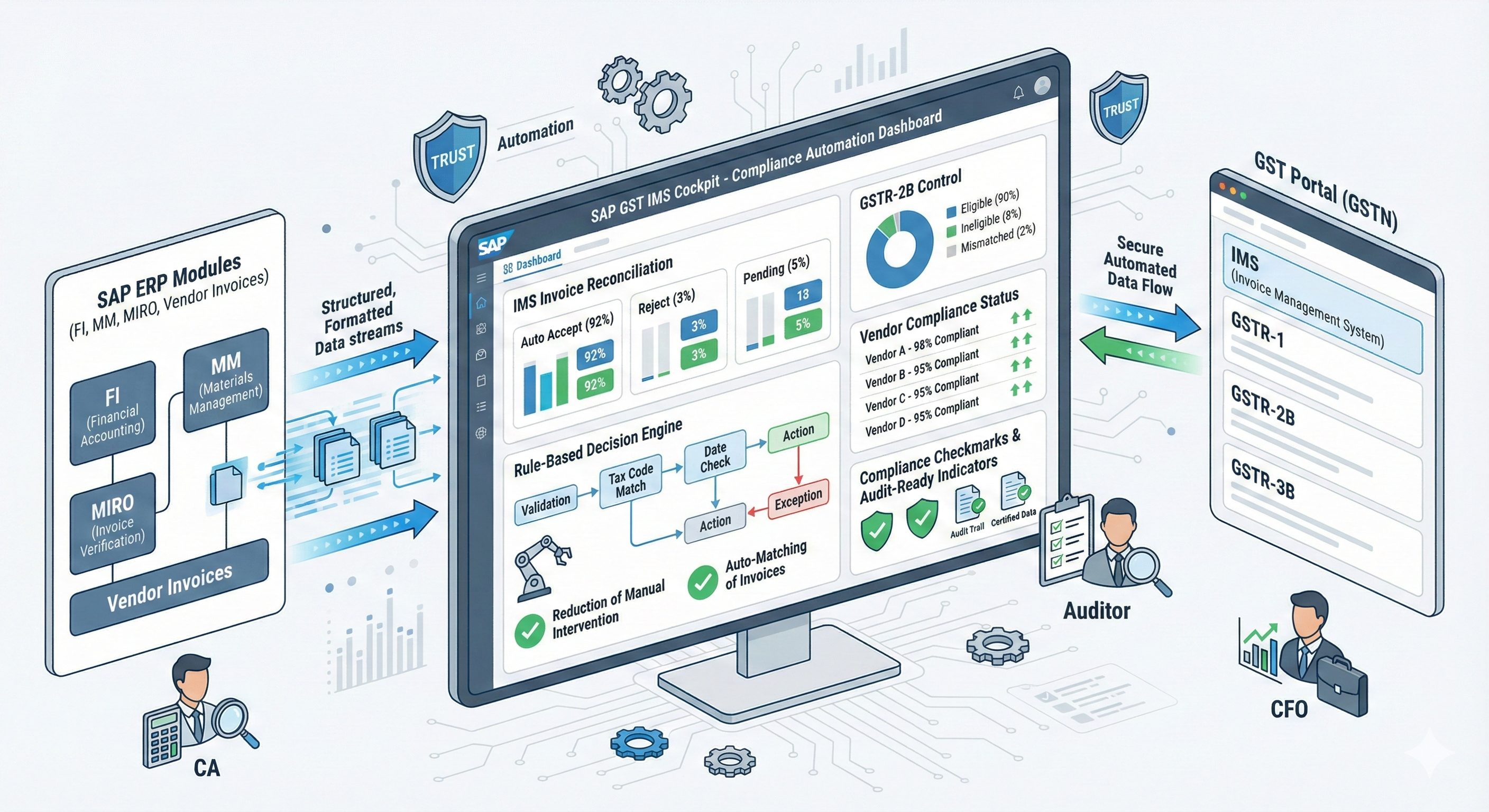
This is exactly what the SEPFUST SAP GST IMS Cockpit makes possible.
SEPFUST SAP GST IMS Cockpit-How Automation Works
1. IMS Invoice Fetch from GSTN
- Secure API pull of IMS Data
- GSTIN wise, time-wise
- Manual downloads are not allowed.
2. Intelligent Reconciliation with SAP
- IMS Invoices will be reconciled with:
- SAP MIRO / FB60 documents
- Vendor GSTIN
- Invoice number & date
- Taxable Value & Tax Breakup
- The taxable
Matching logic involves:
- Exact match
- Fuzzy match (invoicing numbering discrepancies)
3. Rule-Based Auto Decision Engine
| Scenario IMS Action | |
| Perfect SAP match | Auto-Accept |
| GSTIN mismatch | Auto-Reject |
| Value mismatch | Keep Pending |
| Invoice not in SAP | Pending / Reject |
It eliminates the possibility of human subjectivity
4. SAP-Based IMS Action Cockpit
Users can:
- Display IMS invoices within SAP systems.
- View reconciliation status
- Override decisions using Approval Workflow
- Ensure the audit trail continues
- Elimination of GST Portal dependence for day-to-day operations.
5. Action Push to GST Portal
- Accepted/Rejected/ Pending actions are pushed back to GSTN
- Facilitates correct generation of GSTR
- Precludes Excess or Ineligible ITC
Compliance & Audit Benefits
Insofar as a statutory audit & GST audit is concerned:
1. Effective ITC Defence
- Proof of Invoice Acceptance
- System-based decision logic
- Section 16 Compliance recorded
2. Lowered ITC Reversals
- Wrong credits blocked upfront
- No interest exposure under Section 50
3. Vendor Compliance Improvement
- Rejected Invoices identify Non-Compliant Suppliers
- Data-driven Vendor Follow-Up
4. Litigation Risk Reduction
IMS trail acts as primary evidence in:
- GST audits
- Departmental scrutiny
- ITC disputes
IMS Reconciliation & Internal Controls (ICFR Perspective)
From an ICFR/ Internal Auditing perspective:
- Automatic IMS reconciliation is an important proactive control
- Decreases risk associated with human intervention
- Enhances management reporting & MIS
The cockpit in SEPFUST
- Maker-Checker workflows
- Role-based access
- Period locking
- Complete logs
Which Entities Should Mandatorily Implement IMS Automation?
- SAP ECC / S/4HANA users
- Businesses with multi-GSTIN operations
- Manufacturing, FMCG, Pharma, Retail, Infra
- Companies frequently receiving ITC notices
- CFOs planning for zero-surprise GST Audits
IMS is the Future of ITC Governance
GST IMS is not just another GST feature — it is a shift in ITC philosophy:
From claiming credit to proving credit eligibility upfront.
Organizations that continue with manual IMS reconciliation will face:
- Credit leakages
- Operational bottlenecks
- Audit challenges
A SAP-native IMS Cockpit like SEPFUST’s transforms IMS from a compliance burden into a strategic control system.
About SEPFUST
SEPFUST provides SAP-embedded GST automation solutions covering:
- IMS reconciliation
- GSTR-2B & 2A reconciliation
- GST returns automation
- Vendor compliance dashboards
All designed by GST professionals and SAP experts for Indian enterprises.
Frequently Asked Questions (FAQs) – GST IMS Reconciliation
1. What is GST IMS reconciliation?
GST IMS reconciliation is the process of reviewing supplier invoices uploaded to the GST Invoice Management System and taking invoice-level actions—Accept, Reject, or Pending—before such invoices flow into GSTR-2B for ITC eligibility.
2. Is IMS reconciliation mandatory under GST law?
Yes. While IMS is a system functionality, its impact is statutory because only invoices accepted through IMS are eligible for ITC under Section 16 of the CGST Act read with Rule 36(4). Non-action can directly affect ITC availability.
3. How is IMS different from GSTR-2B reconciliation?
IMS reconciliation happens before ITC is generated in GSTR-2B, whereas traditional 2B reconciliation happens after ITC reflection. IMS is preventive, while 2B reconciliation is corrective.
4. What happens if an invoice is kept pending in IMS?
Invoices marked as “Pending” do not flow into GSTR-2B for ITC. Credit remains blocked until the invoice is accepted in IMS in a subsequent period.
5. Can incorrect invoices be rejected in IMS?
Yes. Invoices with incorrect GSTIN, wrong tax structure, fake uploads, or non-business transactions should be rejected to avoid wrongful ITC and future litigation.
6. What is the impact of IMS on vendor compliance?
IMS improves vendor discipline by highlighting incorrect or non-compliant invoices upfront. Rejections and pendings act as data-driven feedback for vendors to correct filings timely.
7. Is manual IMS reconciliation practical for large enterprises?
No. Manual IMS reconciliation is not scalable for organizations with high invoice volumes, multiple GSTINs, or SAP-based accounting systems. Automation is critical to ensure accuracy and timeliness.
8. How does SAP help in IMS reconciliation?
SAP provides structured invoice data through MIRO and FI postings. When integrated with a GST IMS Cockpit, SAP enables automated matching, rule-based decisions, and seamless action updates to the GST portal.
9. What is SEPFUST’s SAP GST IMS Cockpit?
SEPFUST’s SAP GST IMS Cockpit is an SAP-embedded solution that automates IMS invoice fetching, reconciliation with SAP data, rule-based Accept/Reject/Pending decisions, and direct action updates to GSTN.
10. Does IMS automation help during GST audits?
Yes. IMS automation creates a complete audit trail with invoice-level decisions, system logic, timestamps, and approvals—significantly strengthening ITC defence during GST audits and departmental scrutiny.
11. Can IMS reconciliation reduce ITC reversals and interest?
Absolutely. By blocking ineligible ITC at source, IMS reconciliation reduces reversals, interest exposure under Section 50, and penalty risks.
12. Who should implement SAP-based IMS automation?
IMS automation is highly recommended for:
- SAP ECC / S/4HANA users
- Companies with multiple GSTINs
- Manufacturing, FMCG, Pharma, Retail, and Infrastructure sectors
- Enterprises aiming for audit-ready GST compliance
SEPFUST’s SAP-embedded GST IMS Cockpit automates invoice reconciliation, rule-based accept/reject actions, and GSTN integration, ensuring accurate ITC, reduced risk, and audit-ready GST compliance.

Rishi Raj
Rishi Raj is a marketing professional with strong domain expertise in Finance and Technology, bringing over 3+ years of experience in driving growth-led marketing initiatives. He has a proven track record in building scalable go-to-market strategies, demand generation, and positioning technology products for measurable business impact.