
The handwritten signature is quickly becoming outdated in India's digital-first economy. The Digital Signature Certificate (DSC) is now the industry standard for authentication, whether you are signing electronic invoices, filing GST returns, or submitting Ministry of Corporate Affairs (MCA) forms.
However, knowing the DSC is only half the fight for companies handling thousands of documents. Managing these signatures effectively without impeding operations is the true challenge.
This guide explains how Sepfust helps businesses automate this crucial compliance step and covers all you need to know about DSCs, from classes and benefits to the application process.
What is Digital Signature Certificate (DSC)?
The electronic version of a physical signature is called a Digital Signature Certificate (DSC). In the online world, it acts as identity verification for a person or an organization.
A DSC verifies electronic documents (PDFs, XMLs, etc.) in the same way that a physical signature verifies paper documents, guaranteeing:
- Authentication: Confirms the identity of the signer.
- Integrity: Verifies that the signed document hasn't been changed.
- Non-Repudiation: The signer is unable to later retract their signature.
In India, Certifying Authorities (CAs) with licenses from the Controller of Certifying Authorities (CCA) issue DSCs.
Understanding DSC Classes: Why Class 3 Matters
In the past, certificates were divided into three classes (Class 1, 2, and 3). To simplify security, however, considerable adjustments have been made.
Class 3 DSC (The Gold Standard)
The CCA required that Class 3 be the norm for all high-security transactions starting in 2021.
- Use: GST filings, income tax returns, MCA/ROC compliance, e-tendering, and trademark filing.
- Security Level: Highest. Before being issued, it must undergo stringent identity verification (Video KYC).
(Note: Class 2 Certificates are no longer available. You must renew your Class 2 token as Class 3 if it has expired.
What are the benefits of DSC?
Top 5 Benefits of Using a DSC:
1. Statutory Compliance
A DSC is required for Indian companies; it is not an option. Without one, you cannot submit ROC forms, GST returns, or income tax audits.
2. Enhanced Security
A DSC employs cryptographic encryption (PKI), in contrast to a scanned image of a signature, which is easily forged. The signature is instantly void if the document is altered.
3. Time and Cost Efficiency
It is costly to physically sign documents, courier them, and store paper files. DSCs allow you to sign agreements or invoices instantly from anywhere.
4. Global Validity
Cross-border contracts are seamless because digital signatures based on common PKI technology are accepted worldwide.
5. Green Workflow
Going paperless benefits your business as well as the environment. Printing and physical archiving are no longer necessary thanks to DSCs.
How to Get Digital Signature Certificate and Download?
Getting a DSC is a straightforward process for individuals, but it requires strict verification.
Step 1: Choose a Certifying Authority (CA)
You can purchase a DSC from licensed CAs like eMudhra, Capricorn, Pantasign, or Verasys.
Step 2: Submit Documents & KYC
You will need to submit:
- PAN Card & Aadhaar Card.
- Passport/Driving License (for identity proof).
- GST certificate (for organizational DSCs).
Step 3: Verification
Complete the Mobile and Video verification process initiated by the CA.
Step 4: Download to USB Token
Once approved, the DSC is "downloaded" into a FIPS-compliant USB Crypto Token (often called a "dongle"). This physical token must be plugged into your computer whenever you need to sign a document.
The Hidden Challenge: Managing DSCs in an Enterprise
While getting a DSC is easy, using it at scale is a nightmare for finance and IT teams.
Most large organizations face the "USB Token Bottleneck":
- Manual Dependency: To sign 500 invoices in SAP, a user must manually plug in the token and often sign them one by one or in small batches.
- Risk of Loss: Physical tokens are easily lost or misplaced.
- Driver Issues: Constant struggles with Java updates and token drivers on local PCs.
The Solution: Digital Signature in SAP Automation
If your business runs on SAP, you don't need to rely on manual USB tokens for every transaction.
Sepfust offers a specialized SAP Digital Signature Automation solution.
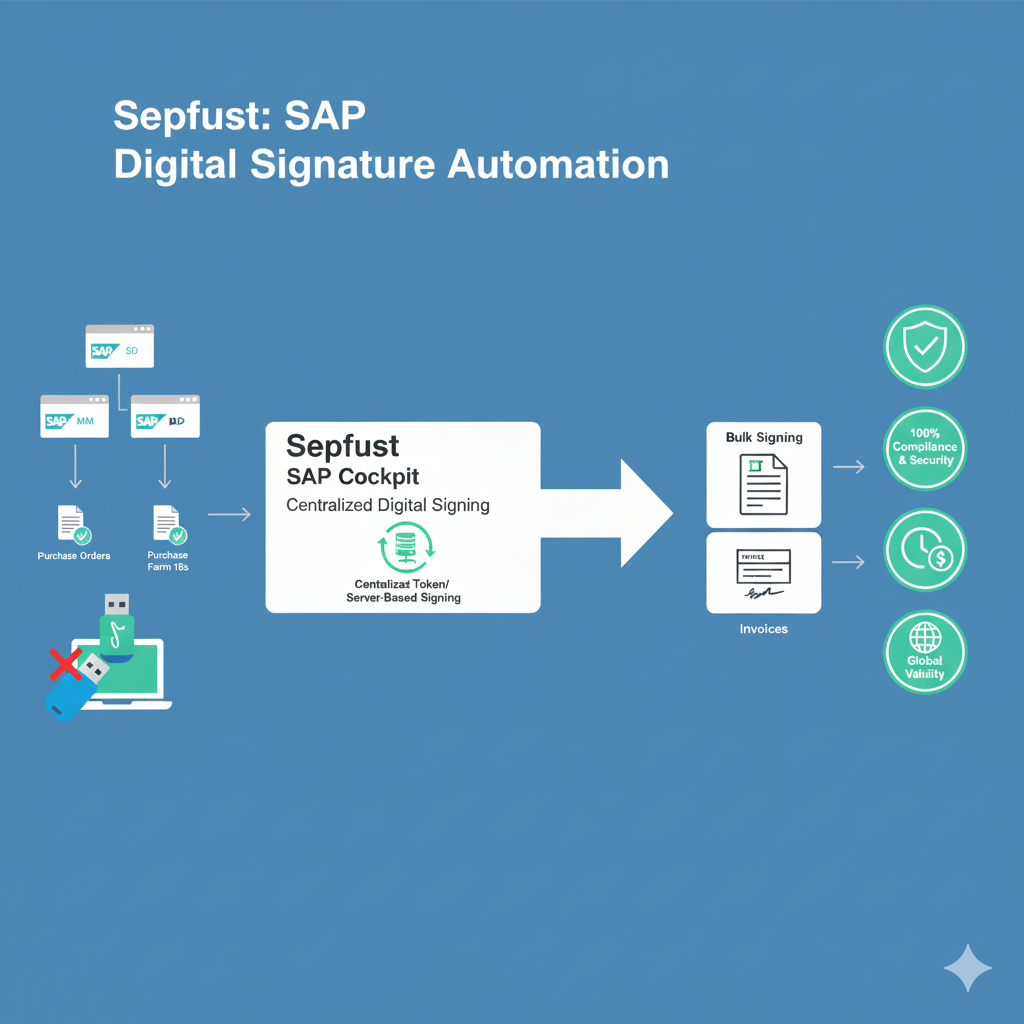
We replace the manual "plug-and-play" struggle with a centralized SAP Cockpit.
- No More Dongles: We help you transition to server-based signing or centralized token management.
- Bulk Signing: Sign thousands of invoices, POs, or Form 16s directly within SAP with a single click.
- 100% Integrated: Data never leaves your SAP system, ensuring maximum security.
Conclusion
In India, a Digital Signature Certificate is essential for conducting business legally. But astute companies understand that having a DSC is only the beginning.
You need to automate the process if you want to fully benefit from digital signing. Your finance team shouldn't be slowed down by manual token usage.
Looking to streamline your DSC workflow in SAP? 👉 Explore Sepfust’s Digital Signature Automation Tool
Sepfust provides enterprise-grade compliance automation, integrating secure DSC and e-invoicing solutions directly into SAP/Oracle to eliminate manual errors and streamline statutory filings.

Rishi Raj
Rishi Raj is a marketing professional with strong domain expertise in Finance and Technology, bringing over 3+ years of experience in driving growth-led marketing initiatives. He has a proven track record in building scalable go-to-market strategies, demand generation, and positioning technology products for measurable business impact.