

GST Compliance, From Manual Burden to Automated Excellence
Filing the Goods and Services Tax in India is something that businesses have to do by law under the CGST Act, 2017. For most companies the Goods and Services Tax compliance is a complicated and lengthy process that is prone to mistakes. The Goods and Services Tax return filing is difficult because businesses have to deal with a lot of information, tight deadlines and matching invoices.
The rules for the Goods and Services Tax also change a lot, which makes it even harder for companies, with a lot of transactions to file their Goods and Services Tax returns.
This is where SAP ERP, combined with SEPFUST Solutions’ SAP GST Cockpit, transforms GST compliance into a seamless, automated, and audit-ready process.
In this blog, we explain:
- The end-to-end GST return filing process
- Challenges faced by businesses
- How SAP automates GST returns
- Role of GST Portal, ASP, and GSP
- How SEPFUST SAP Cockpit simplifies GST compliance
- A real-life SAP GST automation case study
Understanding the GST Return Filing Process Under CGST Law
Legal Framework
The rules, for filing the Goods and Services Tax return are decided by things.
GST return filing is governed by:
- Section 37 of CGST Act, 2017 – Furnishing details of outward supplies (GSTR-1)
- Section 38 – Auto-generated inward supplies (GSTR-2B)
- Section 39 – Monthly/Quarterly returns (GSTR-3B)
- Rule 59 & Rule 60 of CGST Rules
Every person who is a registered taxpayer must make sure that they do what is required of them as a taxpayer. Every registered taxpayer has to follow the rules that apply to registered taxpayers.
- Accurate invoice reporting
- Timely filing
- Reconciliation with government data
- End-to-End GST Process: From Invoice Creation to GSTR-1 Filing
Step 1: Invoice Creation in SAP
The Goods and Services Tax journey begins when you create an invoice. This is where the Goods and Services Tax process really starts. You have to think about the Goods and Services Tax from the beginning, which is when you make an invoice for something.
- Sales invoices (SD Module)
- Purchase invoices (MM/FI Module)
SAP captures:
- GSTIN of supplier & recipient
- HSN/SAC codes
- Tax rates (CGST, SGST, IGST, Cess)
- Place of supply
Any error at this stage leads to downstream reconciliation failures.
Step 2: E Invoicing Integration with SAP
For applicable taxpayers (as notified under Rule 48(4)):
- The company uses a system where invoices are sent from SAP to IRP. This is how they do it. Invoices are pushed from SAP to IRP.
- They got the IRN and the QR code and also the acknowledgment. The IRN is there. So is the QR code. I have the acknowledgment.
- The information goes to the GST Portal automatically for the GSTR-1. This means that people do not have to do anything for the data to get to the GST Portal for the GSTR-1. The data just gets sent to the GST Portal for the GSTR-1 on its own.
The SEPFUST SAP Cockpit makes sure that the SEPFUST SAP Cockpit is really helpful. It does a lot of things. The SEPFUST SAP Cockpit is very useful because it helps people with the SEPFUST SAP Cockpit to do their jobs better.
- Real-time e-invoice status tracking
- Error handling & retries
- IRN mismatch resolution
Step 3: E Way Bill Automation
For movement of goods:
The SAP system helps to create an e-way bill. This is an useful feature of the SAP system because it makes the process of generating an e-way bill a lot easier. The e-way bill is generated by the SAP system. This means that people who use the SAP system do not have to do it. The SAP system does it for them. It is a help to have the SAP system generate the e-way bill.
We have all the details about the vehicle, how far it is going and the information, about the transporter. The vehicle details are captured the distance it will travel is. The transporter data is also recorded.
The SEPFUST Cockpit enables you to do a lot of things. It is a tool that helps people. The SEPFUST Cockpit is very useful. With the SEPFUST Cockpit you can do tasks. The SEPFUST Cockpit is made to make work easy.
- Invoice ↔ E-Way Bill linkage
- Expiry alerts
- One-click regeneration
Step 4: GSTR 1 Data Preparation in SAP
SAP is putting things together. Making them into one unit. The company SAP does this to make things more simple and easy to manage. SAP makes sure that all the different parts of the business are working together. This is what SAP does when it consolidates.
- B2B, B2C, Export, Credit/Debit notes
- HSN summary
- Nil-rated & exempt supplies
- SAP GST reports are generated automatically—ready for reconciliation.
GST Reconciliation: The Biggest Compliance Challenge
Reconciliation Points
| Source | Data Compared |
| SAP vs E-Invoice | Invoice-level validation |
| SAP vs E-Way Bill | Quantity & value |
| SAP vs GST Portal | GSTR-1 vs Portal Data |
| GSTR-2B vs Books | ITC eligibility |
Common Challenges
- Missing invoices in GSTR-1
- Duplicate IRNs
- Tax mismatch due to rate/config issues
- Manual Excel reconciliations
- Last-minute firefighting before due dates
How SAP Automates GST Returns with SEPFUST GST Cockpit
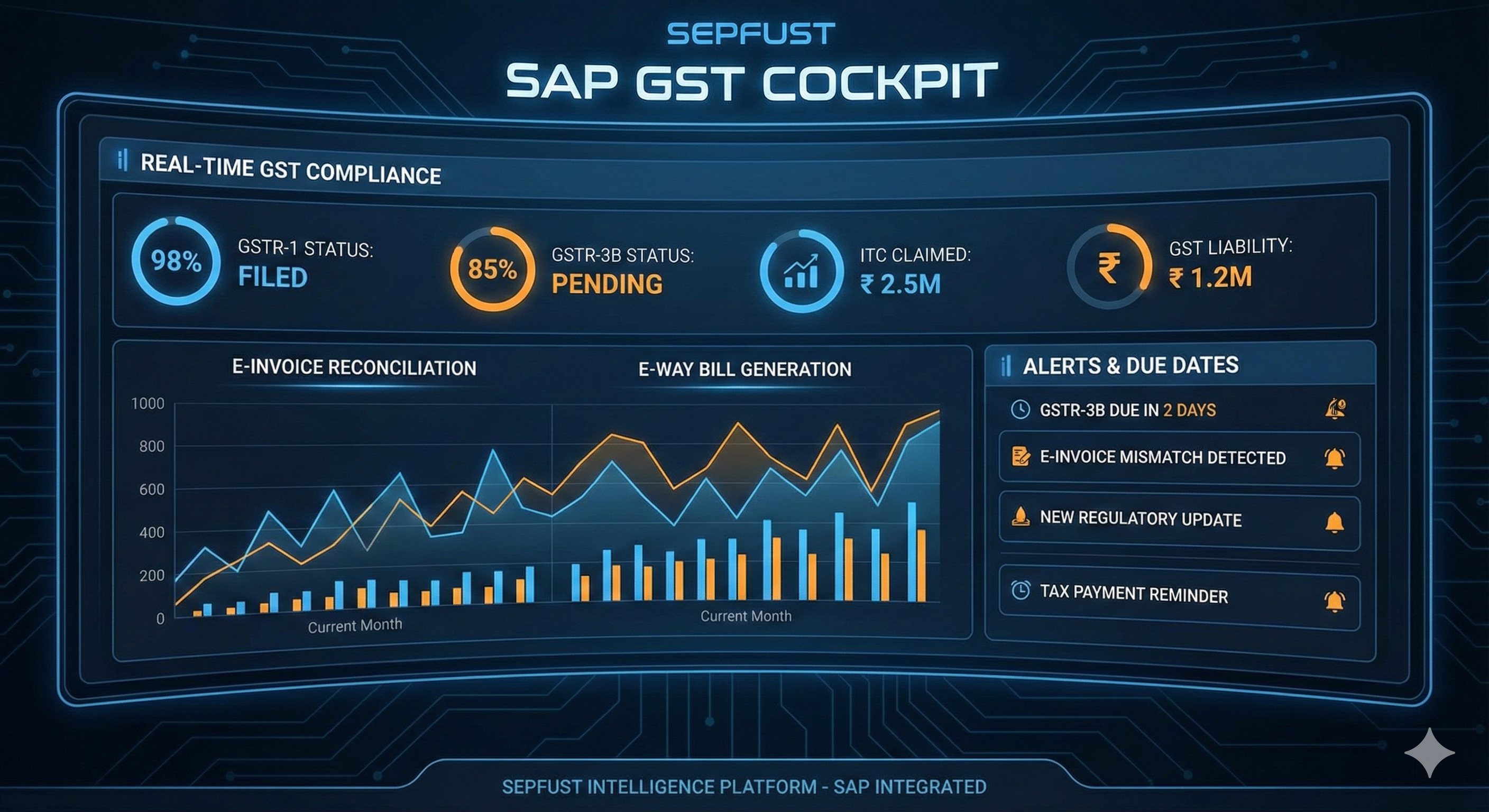
SEPFUST SAP GST Cockpit – A Centralized Compliance Engine
SEPFUST provides a custom SAP GST Cockpit that sits within SAP ERP and acts as a single control tower for GST compliance.
Key Automation Features
- End-to-End GST Automation
- Invoice to return lifecycle tracking
- Real-time GST status dashboards
Automated Reconciliation
- SAP vs GST Portal
- SAP vs E-Invoice & E-Way Bill
- Exception-based reporting
- One-Click GSTR-1 Filing
- Validated data pushed to GST Portal via ASP/GSP
- Reduced dependency on offline utilities
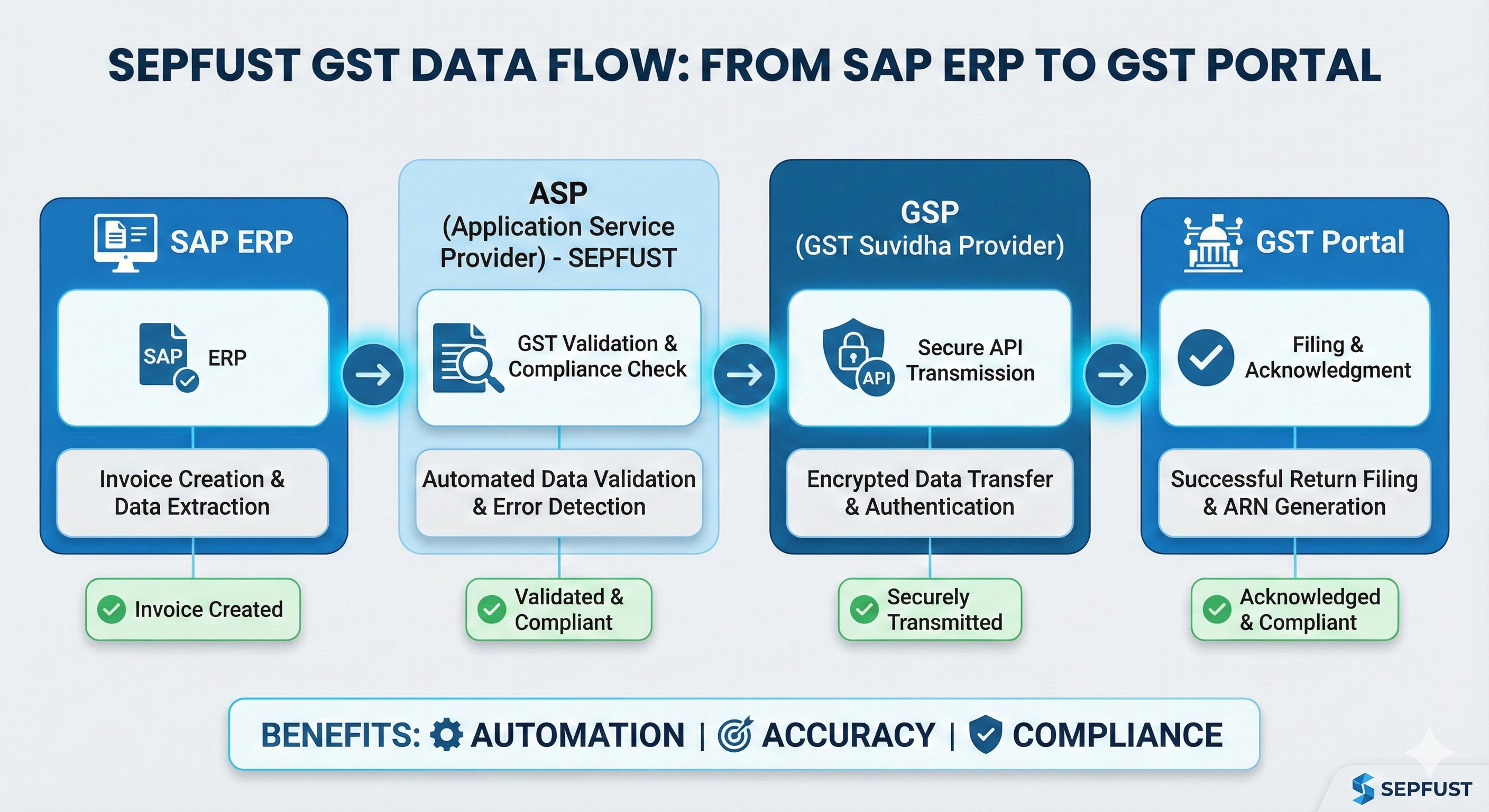
Role of GST Portal, ASP, and GSP Explained
GST Portal
- Government portal for return filing and compliance
- Source of GSTR-2B, filing acknowledgments
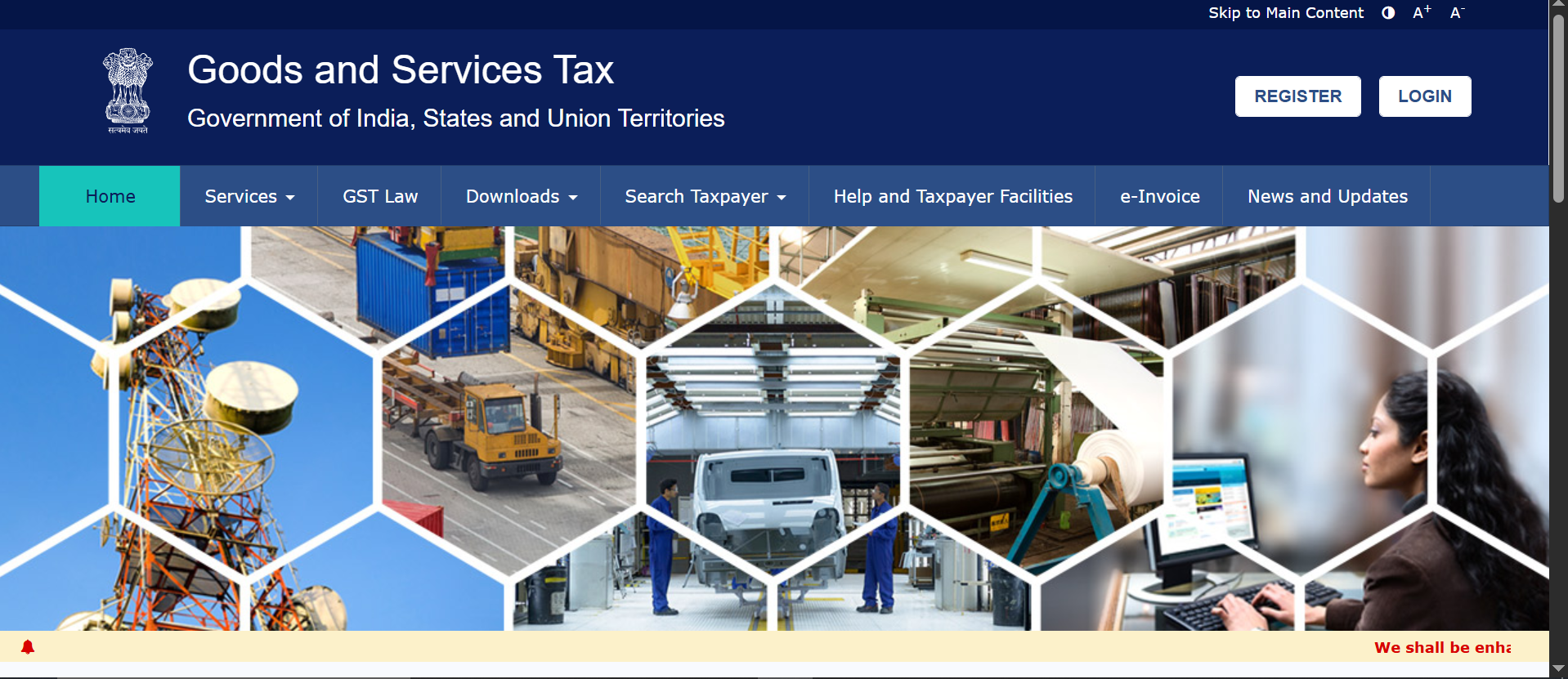
GST Portal Link - https://www.gst.gov.in/
ASP (Application Service Provider)
- Prepares, validates, and reconciles GST data
- Ensures schema-level compliance
GSP (GST Suvidha Provider)
- Authorized API connector with GST Portal
- Secure data transmission
SEPFUST integrates SAP directly with certified ASP & GSP, enabling:
- Secure API-based filing
- Real-time acknowledgments
Error messages within SAP itself
- Automated GST Due Date Reminders & Compliance Alerts
- Missing GST deadlines leads to:
- Late fees (₹50/day)
- Interest @ 18%
- ITC blockage
SEPFUST SAP Cockpit Reminder System
- GSTR-1, GSTR-3B, E-Invoice cut-off alerts
- Role-based email & SAP notifications
- Pending action dashboards for finance teams
No more manual calendar tracking. SAP reminds you.
Real-Life Case Study: SAP GST Automation for a Large FMCG Company
Client Profile
- Multi-state FMCG manufacturer
- 1.5+ lakh invoices/month
- Multiple GST registrations
Challenges
- Manual GSTR-1 preparation
- Frequent mismatches with e-invoice data
- Delayed filings and notices from department
SEPFUST Solution
- Implemented SAP GST Cockpit
- Automated e-invoice & e-way bill reconciliation
- Direct GSTR-1 filing from SAP
Results
- 90% reduction in manual effort
- Zero GST notices post-implementation
- Filing completed 3 days before due date
- Complete audit trail within SAP
Read in detail - Case Study
Why Choose SEPFUST Solutions for SAP GST Automation?
✔ SAP-native GST solutions
✔ Deep GST law understanding
✔ ASP/GSP integrated architecture
✔ Scalable for large enterprises
✔ Audit-ready & future-proof
Conclusion: Transform GST Compliance with SAP & SEPFUST
GST compliance doesn’t have to be stressful. With SAP ERP and SEPFUST Solutions’ SAP GST Cockpit, businesses can achieve:
- Accuracy
- Automation
- Timely compliance
- Complete visibility
How GST Return Filing is Easy with SAP ERP is no longer a concept—it’s a proven reality.
Ready to Automate Your GST Returns?
🌐 Visit: www.sepfust.com
📩 Contact SEPFUST Solutions today and simplify GST compliance once and for all.
Frequently Asked Questions (FAQs)
SAP GST Automation & SEPFUST Solutions
1. How does SAP make GST return filing easy?
SAP automates GST return filing by capturing tax data directly at the invoice creation stage and processing it throughout the transaction lifecycle. With SAP, GST data flows seamlessly from sales and purchase invoices to GSTR-1 and GSTR-3B, minimizing manual intervention, errors, and dependency on Excel-based processes.
When enhanced with SEPFUST SAP GST Cockpit, SAP becomes a centralized GST compliance platform with end-to-end automation and reconciliation.
2. What is SEPFUST SAP GST Cockpit?
SEPFUST SAP GST Cockpit is a SAP-native compliance control tower designed to manage the entire GST lifecycle within SAP ERP.
It enables:
- Invoice-level GST validation
- E-Invoice and E-Way Bill automation
- GSTR-1 preparation and filing
- SAP vs GST Portal reconciliation
- Due-date reminders and compliance alerts
All activities are tracked and monitored from a single dashboard.
3. Can SEPFUST automate GSTR-1 filing from SAP?
Yes. SEPFUST enables direct GSTR-1 filing from SAP through secure ASP and GSP integration.
Validated GST data is pushed from SAP to the GST Portal via APIs, eliminating the need for manual uploads or offline utilities.
4. How does SEPFUST handle e-invoice compliance?
SEPFUST integrates SAP with the e-invoice IRP system to:
- Generate IRNs in real time
- Handle rejections and error corrections
- Reconcile SAP invoices with e-invoice data
- Ensure compliance under Rule 48(4) of CGST Rules
All e-invoice statuses are visible within SAP itself.
5. Is e-way bill generation also automated in SAP?
Yes. SEPFUST automates e-way bill generation and management directly from SAP ERP.
Features include:
- Invoice-linked e-way bills
- Expiry alerts
- Vehicle updates
- Reconciliation with invoice and e-invoice data
This ensures compliance for the movement of goods without manual portal dependency.
6. How does GST reconciliation work in SEPFUST SAP Cockpit?
SEPFUST provides automated, exception-based GST reconciliation, including:
- SAP vs E-Invoice data
- SAP vs E-Way Bill data
- SAP vs GST Portal (GSTR-1)
- Purchase data vs GSTR-2B for ITC validation
Only mismatches are highlighted, enabling faster resolution and audit readiness.
7. What are ASP and GSP, and how does SEPFUST use them?
- ASP (Application Service Provider) validates and prepares GST data
- GSP (GST Suvidha Provider) securely connects systems to the GST Portal via APIs
SEPFUST integrates SAP ERP with certified ASP and GSP partners, enabling secure, real-time data exchange and filing directly from SAP.
8. Does SEPFUST provide GST due date reminders?
Yes. SEPFUST SAP GST Cockpit includes an automated compliance reminder system that:
- Tracks GSTR-1, GSTR-3B, e-invoice cut-off dates
- Sends alerts via SAP notifications and email
- Displays pending actions on dashboards
This helps avoid late fees, interest, and compliance risks.
SEPFUST Solutions automates GST compliance in SAP ERP with a centralized GST Cockpit, enabling e-invoice, e-way bill, GSTR-1 filing, reconciliation and compliance intelligence for enterprises.

Rishi Raj
Rishi Raj is a marketing professional with strong domain expertise in Finance and Technology, bringing over 3+ years of experience in driving growth-led marketing initiatives. He has a proven track record in building scalable go-to-market strategies, demand generation, and positioning technology products for measurable business impact.