

Nobody talks about this enough, but a GST number can become invalid while you are still doing business with that vendor. Their registration gets cancelled, or suspended, and you have no idea because nothing on the invoice changes. Same format, same 15 digits, looks perfectly fine.
The problem shows up later. Usually during return filing or when an ITC claim gets rejected.
If you are managing a decent number of vendors and suppliers, checking GST numbers manually one by one is just not going to work. The government portal only allows single lookups. So if you have 50 vendors, that is 50 separate searches. For 200 vendors, it becomes a full day job.
This guide is about doing it faster. Specifically, how to check bulk GST number active or inactive status without spending hours on the government portal.
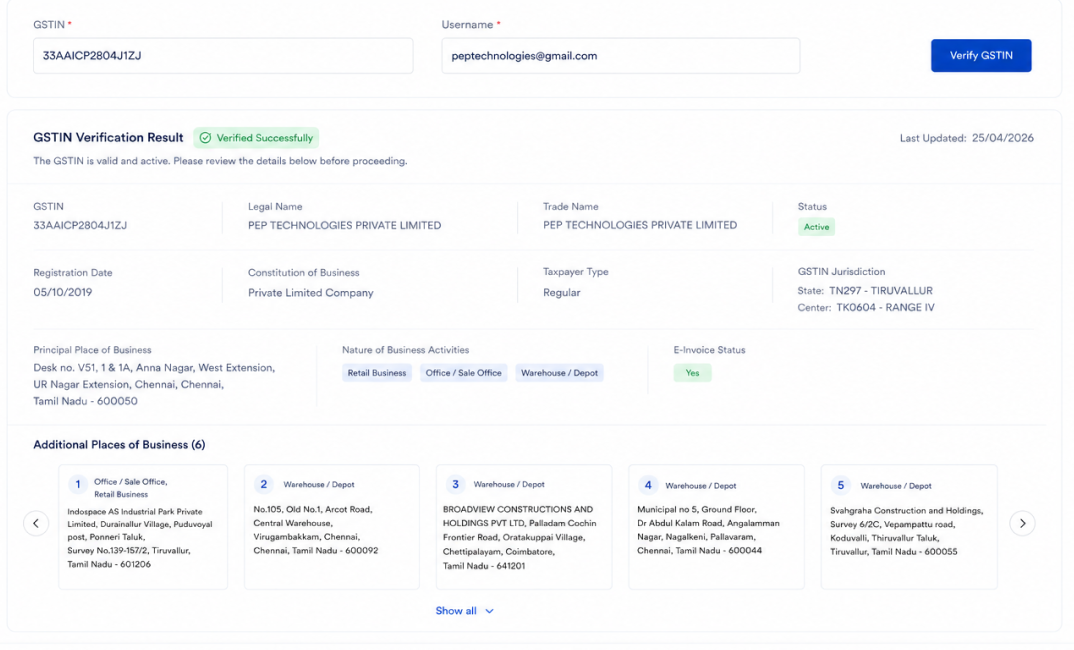
What Active and Inactive GST Status Actually Means
When you look up a GSTIN, the portal shows a status. Most people ignore this field. They should not.
- Active is what you want. The taxpayer is registered, their account is in order, and they should be filing returns. Safe to accept invoices from them.
- Cancelled is a serious problem. The registration is gone. Either the business closed it voluntarily or the GST department cancelled it due to non-compliance. If you claim ITC on purchases from a cancelled GSTIN, you are at risk of that claim being rejected. The tax you paid is not coming back easily.
- Suspended sits in the middle. The registration exists but it is on hold, often because the taxpayer has not been filing returns regularly. Transacting with a suspended GSTIN is risky territory.
- Invalid means the number does not exist in the GSTN database at all. Either someone made a typo or the number is completely fabricated.
The tricky part is that these statuses change over time. A vendor who was fully active when you onboarded them two years ago might be cancelled today. You would not know unless you actually check.
How to Check Bulk GST Number Active or Inactive, Step by Step
1) Get Your List Together First
Before anything else, pull together all the GSTINs you want to verify. Your vendor master list, recent invoices, accounts payable records, wherever they live. Compile them into a single spreadsheet with one GSTIN per row.
While you are at it, do a quick visual check. Every valid GSTIN is exactly 15 characters. The first two are always a state code (like 07 for Delhi or 29 for Karnataka). If anything in your list looks off, flag it before you even start the verification.
2) Pick a Bulk Verification Method
There are two routes depending on what you need.
If you just need to do this occasionally, a bulk GSTIN verification tool is the straightforward option. You upload your CSV or Excel file, the tool runs each number against the GSTN database, and you get a result file back with the status for every GSTIN on your list. The whole thing usually takes a couple of minutes regardless of how many numbers you submitted.
If you are running a business where new vendors get added regularly or you are processing a high volume of invoices, a GST verification API makes more sense. You integrate it once into your system and every new GSTIN gets checked automatically without anyone having to do a manual upload. New vendor added? System checks the GSTIN. Invoice received? Status verified before it even gets processed.
3) Read the Results Carefully
When the results come back, you are looking for anything that is not Active. Go through every Cancelled, Suspended, and Invalid entry and handle them separately.
For invalid GSTINs, go back to the vendor directly. Ask them to confirm their registration number. Sometimes it is a genuine typo. Other times it points to something more concerning.
For cancelled or suspended GSTINs, stop processing their invoices until the situation is clarified. Do not wait until return filing season to deal with it.
4) Save the Report
Once you have verified your list, keep a copy of the result file with the date. This is basic documentation. If you ever get a notice or question about a transaction, being able to show that you verified the GSTIN at the time of the transaction is solid evidence of due diligence.
To Check Bulk GSTIN number Connect us on 👉 WhatsApp or 👉📅 Book Demo
What the Verification Results Actually Show You
A thorough bulk check gives you more than just active or inactive. Here is what comes back for each GSTIN:
| Field | What It Means |
| GSTIN | The number as submitted |
| Legal Name | Official registered name of the business |
| Trade Name | The name they actually operate under |
| State | State of GST registration |
| Registration Date | When they registered |
| Status | Active, Cancelled, Suspended, or Invalid |
| Taxpayer Type | Regular, Composition, Non-resident, etc. |
| Last Return Filed | Indicates how recently they have been compliant |
That last row matters more than people realise. A vendor can technically still be Active but have not filed a return in months. That is a warning sign worth paying attention to before you claim large ITC amounts from them.
Additional Checks to Do Alongside Bulk Verification
Once you have your bulk results, there are two quick manual checks that catch issues bulk tools do not flag.
The name on the invoice should match the legal name in the verification result. If your vendor's invoice says one company name but the GSTN database shows a completely different business, that needs to be investigated before any payment goes out.
The state code in the GSTIN should match where the vendor is actually supplying from. The first two digits of a GSTIN are always the state code. A supplier based in Maharashtra should have a GSTIN starting with 27. If the numbers do not match, ask questions.
Who Needs Bulk GST Number Verification Most
Honestly, any business that deals with GST invoices should be doing periodic GSTIN verification. But the ones who need it most are:
- Businesses with large vendor bases. If you are managing more than 20 or 30 vendors, a quarterly re-verification run is worth building into your routine.
- Accounts and finance teams. Verifying GSTINs before processing invoices and releasing payments is straightforward due diligence. It is much easier to catch issues before payment than after.
- CA firms managing client returns. When reconciliation mismatches show up in GSTR-2A or GSTR-2B, cancelled or suspended GSTINs are often the reason. Checking counterparty GSTINs in advance avoids a lot of that.
- E-commerce platforms with seller onboarding. When you are adding hundreds or thousands of sellers, manual verification is not an option. Automated bulk checking at the onboarding stage is the only scalable approach.
How Often Should You Verify GSTINs
When you first onboard a vendor, verify their GSTIN before you accept any invoice. That is the baseline.
After that, running a fresh bulk check on your entire vendor list every three to six months is a reasonable practice for most businesses. For companies with high invoice volumes or vendors in sectors with compliance issues, monthly checks make more sense.
The point is that it should be a scheduled routine, not something you only do when a problem comes up.
Conclusion
Verifying GST numbers in bulk is not complicated once you have a process for it. Collect your list, run it through a bulk tool or API, review anything that is not Active, and keep a record.
The part that catches people off guard is not knowing that statuses change. A GST number that was valid when you first started working with a vendor might not be valid now. Running these checks regularly is the only way to stay ahead of that.
It is a small habit that prevents much bigger problems.
Connect on 👉 WhatsApp or 👉📅 Book Demo to check bulk GST numbers active or inactive status quickly.
Frequently Asked Questions
Q1. Does the government portal support bulk GSTIN verification?
Answer. No. Only individual lookups are supported. For bulk verification you need a third-party tool or API connected to the GSTN database.
Q2. Is the data from these bulk tools accurate?
Answer. As long as the tool is pulling from the official GSTN source, yes. The status will match what the government portal shows.
Q3. What do I do if a vendor's GSTIN is cancelled?
Answer. Do not accept GST invoices from them until the issue is resolved. Any ITC you have already claimed from that vendor may be at risk. Reach out to them directly to understand what happened with their registration.
Q4. Can I verify GSTINs automatically every time a new invoice is received?
Answer. Yes, with API integration. The check happens in the background without any manual steps.
Q5. How long does bulk verification take?
Answer. For most platforms, a list of a few hundred GSTINs comes back in under two minutes. Larger lists take a bit longer depending on the tool.
Sepfust provides APIs to companies for GSTIN validation. Sepfust also provides GSTIN validation integration program with customer & vendor master for SAP & Oracle ERP.